Activists in San Francisco’s Mission District weren’t giving up easily. David Campos had taken the baton from Chris Daly as the city Supervisor leading the anti-gentrification advocates, who were anchored in a handful of nonprofit community groups. During the springtime festivities for Cinco de Mayo in 2015, Campos called for a moratorium on all new housing construction in the Mission, saying it was the only way to give the district “a fighting chance.”
The idea that new apartment buildings would push rents higher was—and is—a source of endless exasperation for housing advocates. Scott Wiener, who’d taken a more centrist path than Campos, was now on San Francisco’s Board of Supervisors and led the charge against the Mission moratorium, which was voted down twice. It was too drastic a step even for the progressive-leaning Board. But development in the district slowed dramatically in the face of all the political resistance: a proposed 10-story apartment building dubbed “the Monster in the Mission” by activists had become a symbol of the fight and was ultimately abandoned. (As of this writing it was being revived as an affordable housing project, though opposition remains, and no shovels have been turned.)
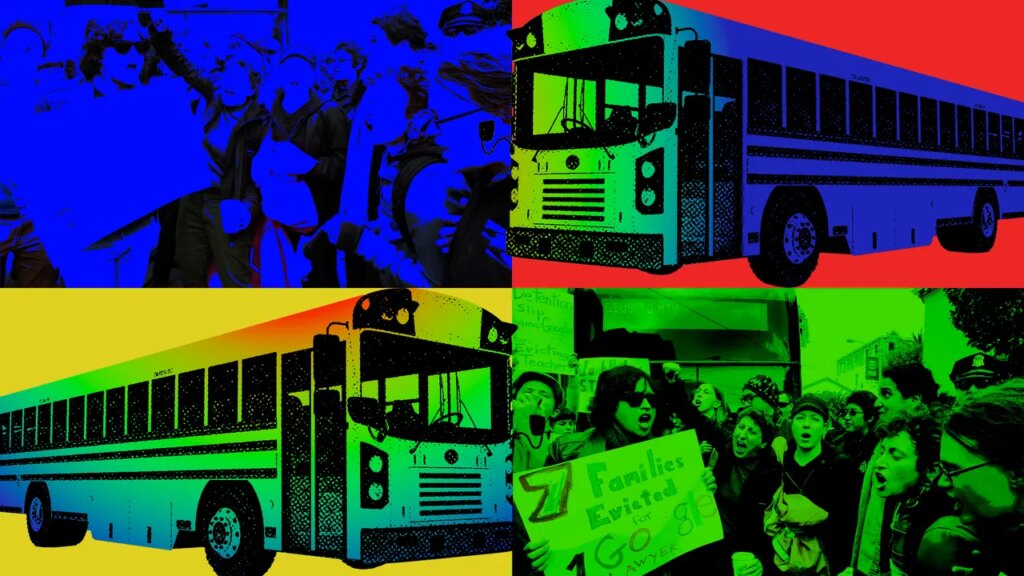
Yet the gentrification arguments weren’t only, or even mainly, about the rent. Nothing would show that better than the theatrical protests targeting what were universally known as the Google buses—or, more commonly in many circles, the “fucking Google buses.”
Cari Spivack, the mid-level Google employee who first created the company’s commuter shuttle program, never imagined she’d be sparking a yearslong political row over whether tech was destroying San Francisco’s soul. Her motivation was simple and personal: She was sick of sitting in traffic.
A designer by trade, Spivack had been working at the networking company 3Com in the early 2000s when she saw the simple elegance of Google’s website, then just a white screen with the Google logo, a box to type your query, and a button that said, “I’m feeling lucky.” Spivack thought its pure functionality was inspiring, and a friend of a friend connected her to a hiring manager at the company. She was brought on as a product manager, joining Google at a magical time when there were just a few hundred employees. It was a dream job—except for the 45-minute white-knuckle commute from her home in Bernal Heights to the Google building in Mountain View.
Buy This Book At:
If you buy something using links in our stories, we may earn a commission. This helps support our journalism. Learn more.
She tried taking Caltrain, the creaking, then-diesel-powered commuter railroad that connected Silicon Valley and the city, but with inconvenient stations and glacially slow and infrequent trains, it took forever. She tried carpooling, and that worked better, but the coordination was a constant hassle. “We’re all leaving at the same time going to the same place on the same road—I thought there has to be a better way,” she recounted later. A friend who worked at Genentech, the biotech pioneer based in the industrial city of South San Francisco, mentioned that the company had a bus that picked people up at the Glen Park BART station and dropped them off at the office. Maybe Google could do that?
“Google was the type of place where you saw the patterns of problems and just came up with solutions,” she says. The company had hired her, in fact, for that very mindset. She was a product manager on the engineering team with no background in engineering. But nobody quite knew what product management was anyway, and she could teach herself programming. She had the quality that was judged “Googley,” as the company would come to call it, and though a computer science degree from a prestigious university would later be all but required for many jobs, it wasn’t like that at the time. Employees were encouraged to think creatively and use 20 percent of their time for their own projects, which could include almost anything—even commuter buses.
“I was yapping about it at lunch with people and they were like, ‘Larry would love that idea,’” she recalled, referring to cofounder Larry Page. A few days later she mentioned it to him in the cafeteria line—the company still worked that way in 2004—and he said sure, figure it out. So she did, researching the cost of a bus, where it would stop, and trying to answer the critical question of whether anyone would actually ride it. Page liked the idea of reducing the company’s carbon footprint, Spivack says, though Sergey Brin was doubtful that people would be willing to leave their cars behind in the city.
Spivack sent a company-wide email to gauge interest, and when almost every employee who lived in San Francisco responded, she figured she’d at least have enough people for one bus. It would pick up at Glen Park BART and at a parking lot near Candlestick Park, and it would make two trips a day in each direction. The company gave her a month to prove the concept.
“I think we had 24 people at the start, and it just kept increasing and increasing and increasing, and we just kept going,” she recounts. Google liked to call everything a “beta test,” which Spivack saw as a wise way to avoid permanent commitments, but her initiative was clearly a winner.
“People started complaining because they lived in a different part of the city, and they’re like, ‘We’d love a stop here, we’d love a stop there.’” She had never envisioned the buses serving the heart of the city, but she dug into her new role as a traffic planner with gusto, researching neighborhoods and streets and possible bus routes and stops, and developing rules on the fly. “I had some things that were really important to me like, number one, the bus should never take a left turn at a traffic light,” she says, lest they provoke delays and angry drivers.
It wasn’t long before some Google engineers volunteered to put wireless on the buses—a novel idea at the time, when Wi-Fi was still emerging and didn’t exist on moving vehicles. Management liked the idea that everyone could keep working. The buses also chipped at the problem of not enough parking in Mountain View, which would become a major motivator later on as Google’s head count soared.
Spivack, who was still doing the shuttle work on her 20-percent time, in 2006 would “roll off ” the project, as they say at tech companies, and a full-time manager would take over. Meanwhile, other big Silicon Valley companies that had a lot of employees living in the city, including Facebook, Apple, and Yahoo, began to spin up their own shuttle services. By the middle of the next decade there’d be many hundreds of tech company buses serving the city, carrying 10,000 people a day.
The commuter shuttles had proliferated in the late 2000s without much fuss. The city was mired in the Great Recession, and with unemployment topping 10 percent and so many mortgages upside down, people had bigger concerns. By the early 2010s, though, it looked like 1999 tech mania all over again, and the buses seemed to be everywhere, with Google deploying the largest fleet. Operated by private firms like Bauer’s Intelligent Transportation, many of them were luxury coaches, sometimes double-decker, much larger than city buses, and they seemed out of place, appearing as outsize apparitions as they crawled across narrow, sloping neighborhood streets, physical symbols of the power of the tech industry and the priority it seemed to enjoy. Since one bus equals dozens of cars, residents in a very environmentally conscious city might have been expected to embrace them, or at least tolerate an efficient form of transit.
That logic did not carry the day.
The complaints began in Noe Valley, an unassuming but increasingly upscale enclave of old Victorians and low-rise apartments just west of the Mission. The tech shuttles, usually black, or white and gray, sometimes used the public bus stops, but they were not for the public. Their patrons stood conspicuously in lines on quiet sidewalks in their Allbirds and jeans, staring at their phones—walking symbols of a new reality in which rich, young professionals, most of them white, were pushing families and the working poor from their homes. Even otherwise prosperous people who couldn’t afford million-dollar homes or $5,000 rents were feeling the squeeze from what had come to feel like an invasion.
Noe Valley wasn’t hip, by any stretch, not like the Mission or certain corners of SoMa, but it had become popular with young families and was also convenient for commuting south to Silicon Valley. As the shuttles proliferated, so did the complaints. Supervisor Bevan Dufty, who represented the neighborhood, led an effort to encourage the buses to use the bigger commercial arteries.
That would quickly backfire: Now the buses were even more visible, and they began using busier city bus stops along already congested commercial corridors, sometimes interfering with Muni service and further irritating neighbors. The city’s Municipal Transportation Agency, which was responsible for traffic as well as trains and buses, tried to engage the companies on possible solutions, such as adjusting routes and stops, but wasn’t making much headway.
Gillian Gillett, who was in charge of transportation policy for Mayor Ed Lee, got a call one morning in the fall of 2013 from a colleague at the MTA, asking her to join a meeting with the tech companies. Gillett, tall and blond, was a data analyst and a commanding presence with intricate knowledge of the issues and little time for posturing. She was often impatient with the city’s lack of tech savvy, and specifically its lack of interest in new tools and new sources of data that would very obviously be helpful in solving transportation problems. She could be withering in her criticism of unreliable politicians and incompetent city bureaucrats, but at the same time was personally offended that attacking tech workers was now part of the playbook for local progressives. She was a techie herself after all, by profession and disposition, even if she’d gone to college at St. John’s in Maryland, a bastion of the liberal arts.
On this day, though, it was the tech companies that were drawing Gillett’s ire.
Google and Facebook and the rest did not need the city’s permission to run the shuttles, since private buses are regulated by the state. And they hadn’t asked. But from a transportation planning point of view there were obvious benefits to working closely with the city. If the MTA knew the shuttle schedules and routes, it could coordinate with the public buses, adjust traffic-signal cadences and move stops around to better keep the traffic flowing. The bus fleets were also collecting a lot of data on congestion and speeds on city streets—information gold for a data analyst like Gillett.
Carli Paine, a friendly MTA staffer with a master’s degree in city planning, had been charged with trying to coordinate with the tech companies and stem the growing number of complaints and conflicts with Muni. About 50 people from the various companies were now gathered in the big conference room on the third floor of the MTA building. Paine was politely trying to explain, again, why the city needed them to share their bus routes and schedules, but she wasn’t getting anywhere. The firms had sent government relations representatives, whose jobs were essentially to refuse anything that wasn’t mandatory, and they were stonewalling; the law said they could mostly do what they wanted, and that’s what they were going to do.
When the Facebook representative began lecturing about how sharing bus schedules would be an invasion of privacy for the people on board—“What if one of the buses was attacked by a terrorist?” she asked—Gillett had heard enough.
“I stood up and said, ‘Hey, I’m from the mayor’s office. Are you kidding me?’”
She held up the latest issue of WIRED magazine, which featured a map of the bus routes, cleverly derived from the social media posts of the Google and Facebook employees riding them. “Are you kidding me?” she demanded again. “Everyone knows where your stops are. Politicians campaign at them, right? Recruiters try to poach employees from other companies at the same stop, right? You’ve got these really big buses, right? It’s not intellectual property we’re talking about here. And you’ve got this very kind civil servant here who is trying to help work this out for everyone, including you.”
Then she shut the meeting down, just 15 minutes in.
“You’re all going to leave because this is a bullshit meeting,” she recalls saying. “You will not meet with the city until you come back with your engineers and your transportation planners.” The meeting dispersed, and a few minutes later she got a text summoning her to the mayor’s office. “What did you do?” Ed Lee demanded. “You just pissed off every tech company in San Francisco.” She explained, and he told her to go home for the day. She retreated to her apartment in the Mission, not sure if she still had a job.
The following Monday, as she was walking to Ritual Coffee, there was a commotion at the intersection of Valencia and 24th Street. Protesters, some of them in clown suits, were blocking a bus and pranking those on board by pretending they were city inspectors and handing out citations. Led by an art collective called Heart of the City, the protesters delayed the bus for about 20 minutes, while celebrating it all on social media. Gillett’s phone buzzed. It was the mayor: “Come see me now.” It seemed the companies were suddenly anxious to meet. Lee told Gillett to get it done. “Within a week we had a meeting that was completely different,” she said later with a wry smile.
The protests, though, had only just begun.
From City on the Edge by Jonathan Weber. Copyright © 2026 by Jonathan Weber. Reprinted by permission of Atria Books, an Imprint of Simon & Schuster, LLC.
The post The Untold Story of the Google Buses That Took Over San Francisco appeared first on Wired.