When I was in Davos earlier this year, I stumbled across a talk by the Israeli philosopher Yuval Noah Harari about artificial intelligence. He was making a provocative analogy. Think about A.I. as a new form of immigration, he said — only this wave of immigration is going to be more intense than anything that’s come before it.
A.I. immigrants are going to flood your economies, he said. They will take your jobs. They will change your culture. They will change your language. If that’s OK with you, fine. If not, Harari said, regulate it now, because in five years’ time, it will be too late.
The analogy has stayed with me because it does two things. It gives a sense of the disruptive potential of A.I. But it also hints at the vast political backlash that could be coming our way. Today, I’m writing about how A.I. could end up reshaping our politics.
What will A.I. do to our politics?
We don’t have the data yet to know exactly how many jobs are at risk from A.I. But early indicators suggest we’re in for a bumpy ride.
In just the past few weeks, companies have cited A.I. to justify tens of thousands of layoffs. Entry-level coding jobs are declining. Other white-collar jobs, like paralegals and researchers, could be next.
A.I. interprets radiology images. It makes pop music. It drives taxis. Regardless of whether we reach the “artificial general intelligence” tech that chief executives promise — machines that are as good as humans at everything — the technology is already powerful enough to threaten generation-defining levels of economic disruption.
And not just economic disruption.
Because what history tells us is that the ripple effects of major economic disruptions are almost never confined to the economy.
The age of machines
In the 18th century, most Europeans were farmers or artisans. Then came the steam engine. The rise of machine power revolutionized production and transformed Europe from a continent of farmers into, eventually, a land of factory workers.
The first Industrial Revolution is the go-to comparison for A.I. optimists. That’s partly because it was so transformative; few other events provide the right sense of scale. It’s also because it generated unprecedented wealth that eventually raised the standard of living almost everywhere.
But the transition was painful. It took many decades, and living standards and life expectancy stagnated or fell before they rose, as people moved into heavily polluted cities and worked 14-hour days.
These shared grievances gave rise to class consciousness and the working class as a political actor, which in turn paved the way for Marxism, socialism and social democracy (not to mention weekends and the eight-hour workday).
I spoke to Carl Benedikt Frey, a professor at Oxford University. He cited the Great Depression as another example of economic disruption that led to profound political transformation. An event that affected people at both the low and high ends of the economic spectrum led to broad demands for a social safety net, and, eventually, the modern welfare state.
A disruption doesn’t have to be on the scale of the Industrial Revolution or the Great Depression to have enormous political repercussions. Consider what’s come to be known as the “China shock” in the United States. Roughly 2 million Americans lost their jobs between 1999 and 2011, after China joined the international trading system.
There were winners and losers, and America didn’t do a very good job of compensating the losers, said Erik Brynjolfsson, the director of the Digital Economy Lab at Stanford University.
The resulting backlash was one reason Donald Trump was elected, as well as why tariffs are at their highest level since the 1930s.
Now consider the potential fallout from A.I. Instead of 2 million people affected, we might be looking at 20 million — or 200 million, Brynjolfsson said.
Humans of the world, unite
Even those who believe there could be a better world on the other side of all this think the transition period will be ugly.
“The pie will get much bigger,” Brynjolfsson said. “But unchecked, there will be a lot of people hurt as well and they will be unhappy.”
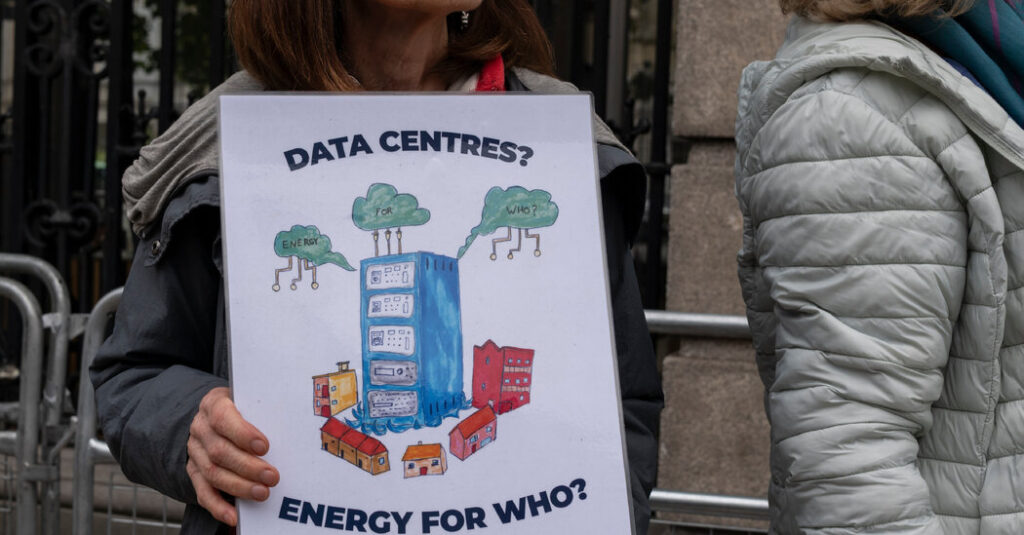
In Canada, Chile, Japan, the U.S. and Switzerland, people are already protesting the data centers that power A.I. Artificial intelligence is more unpopular in the U.S. than ICE, the immigration agency whose agents fatally shot a woman in Minneapolis earlier this year. Political analysts think future elections could be lost and won on A.I.-related issues.
We can already see the backlash; what we can’t yet know are the ways it might rearrange politics in the long term. But the economists I spoke to all made some of the same points:
-
Humans can still control A.I. The decisions that politicians, regulators and companies make now will affect how an A.I.-driven future plays out. Whether and how A.I. is regulated, how the wealth it creates is distributed, the extent to which it replaces or augments human labor — these are political choices.
-
The people who will be displaced by A.I. first will not be blue-collar workers. They will be knowledge workers — members of the educated middle class, the people who, as Frey put it, “write angry op-eds for The New York Times” and who are used to exercising political agency.
-
Concerns about A.I. and how to deal with it bridge the political divide. There are politicians across the American political spectrum, for example, from Bernie Sanders to factions within the MAGA movement, calling for regulation. So is the Pope. A.I. policy could become the basis for new political coalitions.
-
The mere threat of A.I. replacing humans is crystallizing the meaning of human work. Work is a source of identity. It’s also a source of economic and political power. “If you have no way of creating productive value, you can’t strike,” Brynjolfsson said.
Whatever the transition looks like, it’s probably going to play out much faster than the Industrial Revolution — a timeline of a decade or two, not a century. We don’t know what the economic or political future will look like. But we won’t have to wait long to find out.
Related: Who will thrive in the hybrid A.I.-human work force?
MORE TOP NEWS
Trump says Iran shot down a U.S. helicopter
President Trump accused Iran yesterday of shooting down a U.S. helicopter gunship over the Strait of Hormuz. He said in a social media post that “the United States must, of necessity, respond to this attack.” Follow our live updates.
The threat of retaliatory U.S. strikes on Iran came as the Israeli military hit areas across southern Lebanon. At least eight people were killed in an attack on Tyre, one of southern Lebanon’s largest cities, Lebanese officials said.
OTHER NEWS
-
China’s leader, Xi Jinping, wrapped up a two-day visit to North Korea. We took a look at the meaning behind the pageantry.
-
Many people were feared trapped under rubble from the largest earthquake to hit the Philippines in decades. The death toll rose to 38.
-
The police in Northern Ireland arrested a man on suspicion of attempted murder after a knife attack in Belfast.
-
Karim Khan, the chief prosecutor of the International Criminal Court, was suspended after allegations of sexual misconduct.
-
Our chief Africa correspondent Declan Walsh reported on the link between Ebola and gold mining. Watch his video.
WHAT ELSE IS HAPPENING
Pope Leo, who is on a visit to Spain, met with Bad Bunny.
TOP OF THE WORLD
The most clicked link in your newsletter yesterday was about falling birthrates and smartphones.
WORLD CUP
The countdown is on
Mexico City is hosting the opening match, Mexico vs. South Africa, tomorrow at 1 p.m. local time, kicking off the global football tournament jointly hosted by Canada, Mexico and the U.S. We’ll be bringing you the highlights.
How big is the World Cup? In a word, colossal. It’s the world’s most prestigious, most lucrative, most viewed single-sport tournament. And the 2026 edition will be bigger than ever.
Tickets revoked: Iran’s football federation said it had lost its ability to issue some tickets to fans just days before the tournament’s start. It blamed the U.S.
Referee barred: A referee from Somalia, one of 52 picked for the tournament, was denied permission to enter the U.S. “I think that they have a problem with my country,” he said.
SIDE HUSTLE OF THE DAY
Betting on Taylor Swift’s wedding
The guest list is a hot topic on sites like Polymarket and Kalshi. Very little has been confirmed about the pop star’s wedding with Travis Kelce, but the prediction markets are buzzing about the location and the invitees. (You can also channel your inner wedding planner and design your own version of their nuptials.)
MORNING READ
Ukraine has been sending swarms of drones to target Russian ports, oil terminals and other facilities on the Baltic Sea. Some have veered off course, though, and have ended up menacing Ukraine’s staunchest allies.
On Monday, Latvia’s military told residents to take cover because of what was thought to be a Ukrainian drone. Officials in the Baltic countries have accused Russia of redirecting Ukrainian drones to create tensions. All the countries are stepping up their defenses and expanding detection systems. Read more about stray drones in the Baltics.
AROUND THE WORLD
On patrol with Tokyo’s trash police
In Shibuya, one of the city’s busiest districts, littering now comes with a price. Under new rules that took effect last week, litterbugs face immediate fines of 2,000 yen, or about $12.50.
Officials say the measure is necessary as Japan grapples with the challenges of overtourism. Up to 60 patrollers monitor the area each day, issuing notices for infractions as small as dropping a single piece of paper. Read more (and find out why there are so few trash cans).
RECOMMENDATIONS
Shop: Which of these Swedish homes would you buy for $1.3 million?
Watch: The low-budget horror movies “Backrooms” and “Obsession” have soared at the box office. Our critics have thoughts.
Jab: The widespread use of drugs like Ozempic is giving scientists a clearer picture of their effects. Here’s what we know.
Test: Can you name these books that helped change the world? Take our quiz.
RECIPE
This recipe for tacos dorados comes from the town of Ojinaga in Chihuahua, Mexico. Cooks there stuff seasoned beef into tortillas and fry them in oil until the shells are golden. The technique keeps the tacos intact as a crispy package.
WHERE IS THIS?
Where is this street?
TIME TO PLAY
Here are today’s Spelling Bee, Mini Crossword, Wordle and Sudoku. Find all our games here.
That’s it for today. See you tomorrow! — Katrin
We welcome your feedback. Send us your suggestions at [email protected].
The post A.I. Politics appeared first on New York Times.