Tiler Peck has a way of dancing inside music, of rushing forward in gleeful bursts or hanging back until the last second like a surfer feeling out the crest of a wave. It’s satisfying when she nails it, but more beautiful when she doesn’t have time to think about being daring and just is.
In her relatively new role as choreographer, Peck has a similar approach: to make steps look the way she hears the music. Does a step want to be sharp or smooth, strong or feathery? Does a sound sound like a particular dancer? When choreographing, she closes her eyes. She listens, often with a finger pressed to her lips. She sways a little, and out the steps flow.
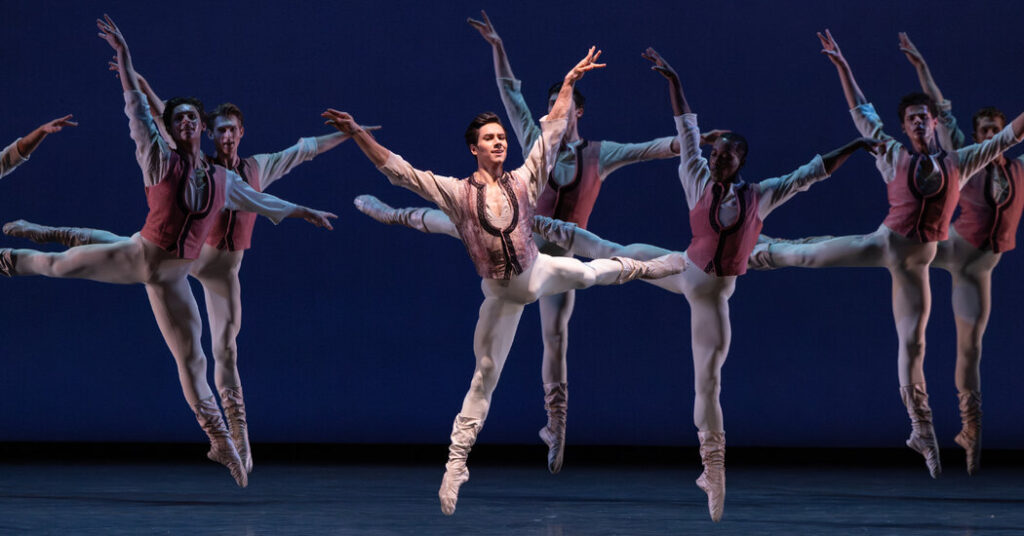
With the premiere of “Symphonie Espagnole” this month at New York City Ballet, Peck passed her physical, visceral response of music onto 40 dancers. With this rare, large-scale ballet, set to music by Édouard Lalo, she used musical intuition to turn each movement of the ballet into a singular, glittering world.
Throughout “Espagnole,” the flavor and flair of Peck’s steps unleash mood as much as physicality. The second movement features all women; the third all men. These male and female tribes aren’t exactly related, yet each pays subtle homage to George Balanchine’s “Serenade,” with its rows of women swirling around the stage.
Certain ballets, like “Serenade,” a work that Peck first danced as a student at 15, illuminate the bond among dancers — the art of moving together, and in the case of “Serenade,” of building a lush sisterhood. In Peck’s second movement, Kloe Walker is a free spirit, a self-possessed leader of eight modern sylphs who surround her with loyal affection. Weaving their way under an overpass of raised arms, the dancers do more than frame Walker, they support her. Walker, in a promenade turn with her leg in attitude, is more than a flowery centerpiece. She’s the queen bee.
Peck shows classroom steps, like a grand battement, from different angles. When the women, balancing on their hands and the pointes of their shoes, kick up a leg, so does Walker, who tops hers with a supple back dip.
Within Peck’s classicism are jazzy touches. Walker, balancing en pointe, suddenly rotates on her heels and stares down at one foot while the other sneaks away — snakily turning in and out. Behind her, the women pirouette in the opposite direction. This sudden opposition is a momentary surprise.
Walker’s dreamy heel walks — echoed by the others — show how effectively Peck’s in-between steps pour into musical notes.
Usually when ballet choreographers take movement to the floor, the modern dancer in me shudders. (Modern dance loves the floor; in ballet, it gets awkward fast.) Peck is an exception. As a transition to the all-male movement, she uses the floor as a simple structural tool. The women, with curving arms and outstretched legs, create a diagonal trail. Raising their hips in a pike, they turn to lie on their backs before the men, full of brio, dash out.
With brisk side somersaults — more sleekly ninja than whimsical — the men crouch behind Roman Mejia. As his taut à la seconde turns ignite the stage, they pat the floor.
Here, led by Mejia, the men stand in profile — a simple yet startling image of male camaraderie — and shift the dance’s rhythm as they walk, changing directions with switchblade precision as their arms rise alongside the sultry violin. The men sink to their shins and join Mejia, still standing, in a resounding clap.
Peck’s male dancers aren’t just athletic. They’re sensual. For an instant, the men press Mejia into the air — the pose he strikes is vaguely showgirl — and then form a line, mirroring his swirling arms in canon. Mejia slows down for a simple step (but far from a throwaway), which sends his foot forward and back as energy trickles down his shoulders to his hips. You see it, you hear it, you feel it. Peck, always sensitive to sound, unlocks Lalo’s groove.
Peck pushes for a softer side of male dancing. Mejia’s strength is less forceful than earthy, like the mossy scent of a forest floor. Peck, who recently became the first woman to dance Mikhail Baryshnikov’s role in Robbins’s “A Suite of Dances,” seems influenced by that experience, intent on expanding the idea of subtle, understated dancing for a new generation. For her, just as women can be strong, men can be soft.
Mejia’s final jump at the very end — a quick airborne rotation to the knee — is a repeat of this earlier moment. Did we need to see it again?
That would be a yes. His arms, curving above as his palms press up, are the finishing touch. Mejia squeezes his fingers into fists and lowers his arms like a prizefighter.
Again, so satisfying! This is Peck’s ballet brotherhood — competitive yet generous. It’s neither the usual, fiery show-off spectacle, nor the sock-swishing contemporary ballet of automatons. It’s the classical path that Billy Elliot might have taken, given the chance. It’s cool in temperature. And it’s cool.
Videos via New York City Ballet.
Gia Kourlas is the dance critic for The Times. She writes reviews, essays and feature articles and works on a range of stories.
The post Watch Tiler Peck Reimagine What Female and Male Dancers Can Be appeared first on New York Times.