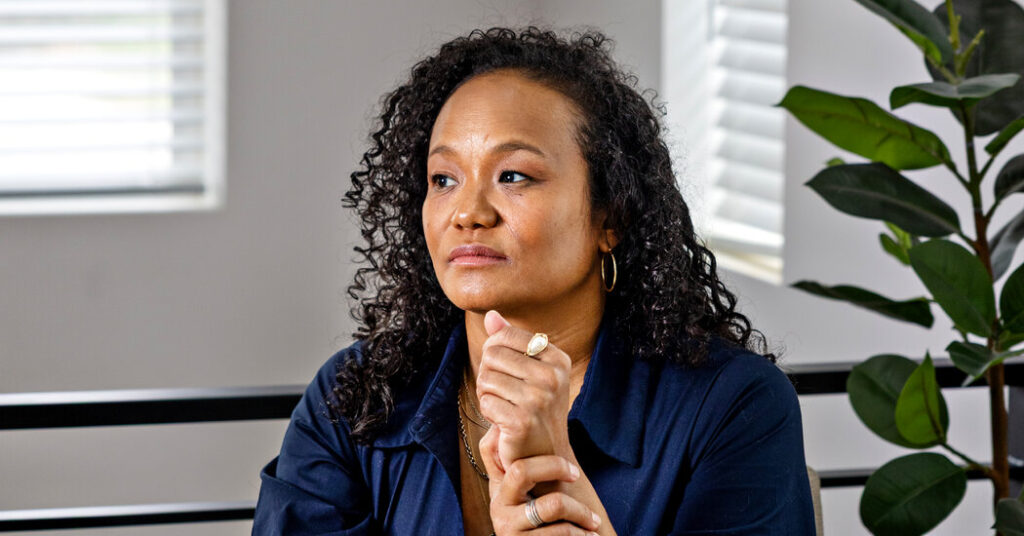
More than anything else in the world, Erin Millender longed to be a mother. She already had a day care picked out, a Pack ’n Play stashed in her basement. She’d tried Chinese pregnancy teas and midnight fertility ceremonies under a full moon in the Caribbean Sea. Whatever it took to have a child.
Now in her mid-40s, Millender knew she was running out of time. She had already spent several years attempting in vitro fertilization, with no luck. She’d decided to give I.V.F. one more try.
“What’s a good day to come in?” Millender asked when she called the clinic in July 2023, hoping to have an embryo placed inside her uterus within a few weeks.
The doctor then delivered the news that would upend Millender’s entire future. Her husband had revoked his consent. She could no longer make a baby with his DNA.
“We can’t move forward,” she recalled the doctor saying. “Our hands are tied.”
And with that, Millender arrived at the center of a contentious new debate dividing courts and couples across the country. As more women turn to in vitro fertilization to build their families — sometimes delaying motherhood into their 40s — some are wrestling with an unfamiliar set of moral and legal questions that arise when children are created in a lab. Among the most contentious: Who has custody of those children before they exist?
Standing on the street in downtown Manhattan, Millender took a cigarette out of her purse and started to pace. A few weeks earlier, in the doorway of their Brooklyn brownstone, her husband had brought up divorce for the first time. But surely, she’d thought, that was just a marital bump, the kind of conflict that might eventually bring a couple closer together. Not one that could destroy the most painstakingly laid plans for a family.
A high-powered lawyer, dressed for a big board meeting, Millender forced herself to set her feelings aside and think strategically.
“What exactly did he say?” she asked the doctor on the phone. “What can I do?”
And most important: “How much time do I have left?”
A Game of Musical Chairs
For Millender, the clock did not start to tick until she turned 35.
She’d settled on that age in her mid-20s as what she called a “drop-dead date” for finding a husband. Entering the work force with an Ivy League degree, she’d decided to take the advice of her mother, who had started a family right out of school. “Don’t get married young,” her mom had always said. “Men can come later.”
By her 30s, Millender figured, a good one would probably show up.
She gave dating her best shot. At age 26, she recalled, she hyped herself up in a Craigslist ad, announcing that she would be strolling through the Container Store in Midtown Manhattan from 7 to 8 on a Tuesday night. “Go find the prettiest girl in the store and introduce yourself,” she’d written. She wanted to engineer the kind of meet-cute you would see in a rom-com. To find a handsome stranger who would sidle up to her shopping cart, then bewitch her with his intellect and wit.
For over a decade, no such man appeared — at the Container Store or anywhere else. She searched for him at weddings. At speed-dating events. Then, eventually, at baby showers and third birthday parties for the children of her married friends.
“In your 20s, the odds are in your favor,” Millender told me, comparing dating to a game of musical chairs. “But you get to your late 30s, and it’s like, wait, there’s nowhere for me to sit. Everyone’s already got a chair.”
Millender’s friends accused her of being too picky. She preferred the word “intentional.” She imposed no minimum height or salary requirements, she would remind them: “He just needs to be able to keep up with me, intellectually.”
She met Adam Rubin for their first date at a dive bar booming with March Madness basketball. He wasn’t the kind of guy she’d ever imagined for herself. With a gold necklace and a well-manicured goatee, Rubin helped run an HVAC company on Long Island and expressed an interest in golf. But he seemed to really care about his family. And he made her laugh.
By the time they had sex a few months later, Millender had identified Rubin as a man she could have a baby with, at least as a co-parent, if not as a husband. So when the moment came to reach for a condom, she said, she told him he could skip that step.
“You should just know, I’m not on birth control,” she said, then age 39. “And at this point in my life, if I get pregnant, I’m keeping it.”
After that, Millender grew increasingly sure of what she wanted. With the women of her Bed-Stuy book club, she collaged a vision board to inspire her year ahead, pasting a photo of herself and Rubin beside the words “Take Control” and “Lead Him to Greatness.”
When he started dragging his feet about moving in, then about proposing, Millender issued clear ultimatums.
“I cannot waste one more day if I want to have children,” she said.
Millender knew the biological facts: Women over 35 have a harder time getting pregnant. They experience more miscarriages and still births. They’re more likely to develop dangerous pregnancy conditions, while their babies are more likely to be born with fetal abnormalities. The older you get, the greater those risks become.
At 41, Millender received a diagnosis of infertility. Her doctor urged her to start I.V.F. as soon as possible, she said.
Millender said Rubin didn’t want to do that until after their wedding: a Covid-masked affair aboard a 1920s-style yacht in the New York City harbor. The couple exchanged rings beneath a canopy monogrammed with their initials, then slow-danced to Natalie Cole’s “Inseparable” as family members wiped away tears.
Millender had already scheduled an egg retrieval at New York University’s I.V.F. clinic for the following month. Finally, she thought, her plan was coming together. She had the guy. She had the wedding. She had insurance that would cover three rounds of I.V.F. There would be no more delays, not if she had anything to do with it.
“I’m proud to say I come here as a woman of many virtues,” Millender said as she delivered her vows on the yacht, staring into her husband’s eyes.
“Patience is not one of them.”
The Breakdown
As is typical when a relationship breaks down, there are two versions of how it happened.
Rubin did not want to talk to me for this article. But I was able to review his recollections of events that he prepared as part of the couple’s divorce proceedings. He also responded in writing to a list of detailed questions.
Both Millender and Rubin recounted a difficult journey through I.V.F. A surgery to remove the fibroids around Millender’s uterus. A failed transfer. Then a retrieval that yielded no viable embryos. And throughout, a looming fear that her uterus was becoming less hospitable with every passing month.
Rubin wrote in his affidavit that he was a “fully engaged participant from the outset,” helping to administer I.V.F. injections and supporting his wife through an emotionally draining process. He printed out motivational posters showing how an egg is fertilized through I.V.F., taping them up on walls around their home.
But as they continued to struggle to conceive, he wrote in his affidavit, Millender grew distant and hostile, moving into a different bedroom and backing out of couples counseling. Eventually, she asked him to stop attending their I.V.F. appointments so she could better focus on the procreative task at hand.
“You are not a priority,” he recalled her saying, according to court records.
Millender remembered things differently. At the time, she had been completely overwhelmed, she said, trying to juggle I.V.F., her job, her marriage and caring for her dying father. Rubin seemed increasingly disinterested in their pregnancy plans, she said. They’d been fighting a lot, and she just needed some space.
Rubin told her he would rather have a healthy marriage than a baby, she said — which seemed to her like a false dichotomy. She wanted both. But one was time-sensitive, she recalled thinking. The other was not.
“I was like, ‘We have the rest of our lives to work on the marriage,’” Millender said. But for a baby, she told him, “we are in the 11th hour.” They had two viable embryos, and she urgently had to get at least one of them inside her.
“Go sit somewhere and golf,” she’d told him. “Go climb Machu Picchu.”
“I am not willing to prioritize resolving our communication issues,” she wrote in an email in June 2023, “over the chance to have a child.”
Rubin visited the I.V.F. clinic two weeks later to ask how to revoke his consent for the procedure. By that point, he had already spoken with a divorce lawyer. He knew he could not raise a child with his wife, he wrote in his affidavit, accusing Millender of “emotional manipulation.” And he did not want to have a child who would never know its father.
“I did not endure the I.V.F. process, assist with medical appointments and injections,” Rubin wrote, “with the intention of being reduced to an anonymous donor.”
That arrangement would “erase my role as a father,” he added, and, by extension, violate his Jewish faith. The Torah instructs Jews to impress its teachings upon their offspring, he wrote — a task he would not be able to complete if his child was a stranger.
Millender begged Rubin to change his mind. A few weeks after he revoked his consent for the transfer, she apologized for ever making him doubt her love for him and promised to change.
“I want to show you that love now, desperately,” she said in a handwritten letter. “I am so sorry I let my fear and pain and sadness hurt you.”
Rubin suggested they hire a mediator he’d selected to discuss custody of the embryos. Their relationship, he said, was “beyond repair.”
Millender — who made more than three times as much money as Rubin — asked her husband to move out of the house she’d lived in for 16 years before they got married. When he refused, she moved into an Airbnb and returned to N.Y.U. alone to freeze a new batch of eggs — ones she planned to fertilize with sperm from a donor. For three months, she watched British period dramas and ate Häagen-Dazs out of the container while she injected herself with ovary-stimulating hormones, lonelier than she’d ever felt.
Whatever it takes to have a child, she reminded herself.
Once that procedure was over, Millender said, her doctor explained just how long the odds were: The doctor knew of no cases in which eggs frozen at age 44 had resulted in the birth of a baby.
The embryos Millender had created with Rubin would almost certainly be her only chance to bear a child.
What Is Fair?
Before Millender and Rubin started their latest round of I.V.F., their clinic had given them a contract to determine what would happen to the embryos if they ever got divorced.
As is standard in many I.V.F. clinics across the country, their contract offered three options. The embryos could be given to one party or the other, donated or discarded.
Millender and Rubin had chosen option No. 1.
Who got the embryos in the event of a breakup would be an issue for a New York divorce court.
If a woman is already pregnant when she divorces, there is no legal doubt that the mother may carry the pregnancy to term if she wants to. The divorced parents would work out a custody agreement for the child, just as they would for any other child they already had.
But the legal question of who should have custody of frozen embryos is far more complicated — and still largely unsettled in American law. Only about one-third of states have considered the issue in an appeals court, where precedent is set, according to Ben Carpenter, a professor at the University of St. Thomas School of Law who analyzed rulings on embryo disputes from 129 judges. That means courts in the vast majority of states have no established legal framework to use to make these decisions.
Absent any precedent, individual judges are left to decide what outcome is most fair. One judge might care most about what each partner plans to do with the embryos; another may value each partner’s relative ability to have a child in other ways. While lower courts tend to side with the person seeking to use the embryos — typically the woman — appellate courts have almost always sided with the person who wants to donate or discard them, according to Carpenter’s analysis.
The issue is just starting to seep into politics, amid a push from the Trump administration to make I.V.F. more accessible. The Michigan Supreme Court last year urged the State Legislature to take up the question of embryo disputes, after declining to hear a related case. And in 2018 Arizona became the first state to pass a law on how to handle the issue, requiring the embryos to go to whichever party was planning to use them to have children.
In New York, “the way these cases are going to trend in the future depends on what happens in this case,” said Steven Gildin, a longtime New York divorce lawyer who represents Millender. “This is going to set the bar.”
Millender filed for divorce about a month before she moved out of her house. Anticipating a fierce legal fight for the embryos, she and her lawyers discussed how best to convince a court that she should be allowed to become a mother. Her lifelong dream was to have a baby, she wrote in her legal brief. Her husband had promised to support that dream. And now, “without the urgent intercession of this court,” she wrote, “I will suffer the irreparable loss of my ability to bear children.”
She had been reluctant to ask Rubin, point-blank, what he planned to do with the embryos if he won custody.
“Likely to be destroyed,” his lawyer said during oral arguments last September.
Millender believed in a woman’s right to end her pregnancy. But she was also a practicing Catholic. Ahead of their I.V.F. procedures, she said, she and Rubin had agreed to do everything in their power not to “waste life.” Now, he wanted to get rid of their embryos. And she had to say, that seemed a lot like he was trying to kill her children.
Rubin later said in his email to The New York Times that he intended for the embryos to be donated to research, not destroyed — the option he and Millender had chosen in an initial contract they signed when they first began I.V.F. in 2021.
By the end of the arguments, Millender felt hopeful that the Brooklyn civil court judge was going to rule in her favor. The judge, Theresa Ciccotto, dismissed Rubin’s arguments about his religious objections as a Jew, then zeroed in on a claim by Millender’s lawyer that he had previously offered to sell the embryos to his wife.
“And that’s despite what the Torah says,” the judge said. “Does the Torah say anything about buying them, selling?”
Rubin’s lawyer said that selling the embryos was not his client’s “intention,” and Rubin later told The Times that he “never instructed my counsel to offer the embryos for sale.”
Judge Ciccotto issued a decision about a week before Christmas last year, granting Millender possession of the embryos.
“If there is anything that the court finds to be truthful and credible, it is plaintiff’s sense of urgency in having children due to her advancing age,” Judge Ciccotto wrote. “However, defendant can always start a family at any time, with someone else.”
Millender’s “interest in obtaining control over the remaining embryos,” the judge continued, “supersedes” any interest Rubin might have.
By the time the ruling came down, Millender had already determined exactly which lawyer at N.Y.U. would need to review it and give the clinic permission to complete the transfer. She immediately forwarded him the decision. Her husband was likely to be furious and file an appeal. She might have only a few weeks to act.
“I knew you were selfish, but not this immoral,” Rubin texted Millender after they got the judge’s decision, referring to her conduct during the divorce.
“There is nothing immoral about choosing life,” Millender responded. “That is always what we said we would do. And I have kept my promise to God.”
“It is potentially life, there is no nefesh,” Rubin said, referring to the Hebrew term for “soul.”
“You know what we agreed and God does too,” she said. “I will leave you to His mercy.”
Rubin said in his statement to The Times that the ruling set a “dangerous legal precedent.”
“The assertion in Erin’s legal filings of an ‘absolute right’ to biological parenthood,” he said, “could negatively impact future legal arguments, and be extremely harmful rhetoric for those unable to achieve parenthood.” He added that he believed the initial contract — in which he and Millender had agreed to donate the embryos to research in a divorce — should take priority in the case.
Millender began taking her I.V.F. medications right away, preparing her body for the embryo. Adamant that Rubin would not rob her of her joy, she invited her doula, her lawyer and her closest friends to a “pre-transfer party.” Over oysters and soft cheeses — things she wouldn’t be able to eat while pregnant — she raised a glass to her “tribe” and the awesome strength of women.
On Jan. 4, Rubin filed notice that he planned to appeal the judge’s decision, unaware that Millender was already planning a transfer, when the doctor would implant the embryo, for Jan. 14. Millender’s lawyers assured her that a notice alone could not legally block the procedure: Until the moment the appellate court paused the lower court’s decision, the embryos were legally hers.
On the day of the transfer, Millender broke down sobbing when she saw the embryo on the ultrasound screen, finally safe.
Her uterus looked like the night sky, she thought. Her baby, a tiny star.
The appellate court halted the judge’s ruling seven days later. Neither party could do anything with the embryos from that point forward.
Millender was already pregnant.
A Pregnancy Revealed
Rubin was looking at her. Millender could see him all the way down the hall, sitting on a bench in his suit. Their eyes met.
He did not look away.
They were in court for a hearing on a Wednesday in mid-March. At past court appearances, her husband had always avoided eye contact, staring straight ahead, jaw clenched and shoulders rigid. But today, he knew she was pregnant with his child. Her lawyer had called the night before to break the news.
“He is clearly affected,” Millender whispered to her lawyers. “How he’s affected is the question.”
Inside the courtroom, Millender’s lawyer told the judge about the pregnancy. The doctor had implanted the embryo before the appeals court paused the judge’s ruling, he said, a claim backed up by medical records.
“Very happy for you. Congratulations,” said Judge Ciccotto, who had granted custody to Millender. “I know how important this was. Believe me, I know.”
Rubin’s lawyer accused Millender of hiding the pregnancy and disrespecting opposing counsel, then suggested that she might be lying about the timing.
“I want to share with the court my complete and absolute outrage,” Rubin’s lawyer said. “I want to know when she was implanted.”
Millender’s lawyer said his client would not seek any child support if Rubin waived his parental rights.
Two weeks later, Rubin filed a restraining order against Millender and asked a judge to order her to stay away from him. He accused his wife of demonstrating “irrational behavior” since they started the divorce, citing offenses like hosting a Memorial Day barbecue at their house after she had moved out and leaving a book on his bed. The title: “Why You Will Marry the Wrong Person.”
Millender didn’t care. Let Rubin accuse her of harassment. Let the lawyers subpoena her doctor and examine her medical records. Her baby was inside her uterus. No ex-husband could change that.
But at 47 years old, her own body made no promises.
Browsing baby stores online, Millender had tabbed and saved a pair of fleece bootees. A onesie covered in giraffes. A little blue towel with an elephant head.
It was too soon to buy anything, she’d decided. She still had 28 weeks to go.
Julie Tate contributed research.
Caroline Kitchener is a Times reporter, writing about the American family.
The post They Started I.V.F., Then Split. Now Who Gets Custody of the Embryos? appeared first on New York Times.