These potato-salad-slinging AI chefs aren’t taking anyone’s jobs. Not yet, anyway. They’re just here as volunteers.
Project Open Hand, a nonprofit founded in 1985 by local grandmother and HIV-awareness advocate Ruth Brinker, prepares and packages meals to meet the diverse nutritional requirements of people who need them. The effort began in response to the AIDS crisis, but the nonprofit has since expanded the meals it makes for people with conditions such as heart disease, diabetes, or chronic kidney disease.
But it takes many people to make these meals, and Project Open Hand has struggled to entice volunteers to help fill the meal kits. The organization is housed in a four-story building in San Francisco’s Tenderloin district. During peak hours, the place feels like a big operation, usually bustling with people. Some of them are there in need of the free meals, some are staff and volunteers there to make the food and keep the place running.
The process of putting together medically tailored meal boxes can get complicated. Different patients have different needs, so the meals that go out for donation cannot be one-size-fits-all and have to account for allergies and nutrient requirements based on people’s needs and medical conditions. That’s where the robots come in.
“It’s not even that they’re faster,” says Alma Caceres, a sous chef who works on the meal prep process at Project Open Hand. “It’s that we don’t have the volunteers.”
Chef Robotics is a San Francisco company that makes “physical AI for the food industry.” It’s one of the many companies focused on building robots that can better handle physical objects. Chef’s automated robots focus specifically on plating—no cooking or chopping—just the act of getting the food on a plate at scale. It has clients for its robo-made meals, such as Amy’s Kitchen and Factor, the frozen-meal company. Chef Robotics is also training its robots to eventually handle more complex tasks, like assembling a hamburger piece by piece.
The partnership with Open Hand came from a chance conversation between employees from the two organizations on the Bay Area Rapid Transit. When presented with the idea, Project Open Hand’s CEO, Paul Hepfer, said the cost of renting the robots felt worth it. (Yes, they pay a subscription fee.)
“Nonprofits often operate under a scarcity mindset, and I think that’s a disservice to the people we serve, because then you’re not looking for innovations or quality improvements,” Hepfer tells WIRED. “There’s not a whole lot of robots, AI, and innovation in the Tenderloin, I would bet.”
San Francisco’s Tenderloin district has long been its most fraught, due to higher levels of crime, people experiencing homelessness, and drug use. If you’ve ever seen stories pushing the narrative that San Francisco is a dirty, unsafe city caught in a “doom loop,” they were probably talking about the Tenderloin.
The Covid-19 pandemic didn’t help either, as people fled the city in droves. Open Hand, which had become particularly dependent on corporate volunteers who came to help assemble meals as part of company-sanctioned charity efforts, found its source of labor had vanished.
San Francisco has made a sort of comeback in the past couple of years, buoyed by the AI boom. But that influx of money and workers has not exactly translated to the kind of corporate chivalry Open Hand had long relied on.
“We used to have so many corporate groups come in here,” Hepfer says. “There are so many new businesses—AI businesses, biopharma businesses—that aren’t engaged the way they were pre-pandemic, which is really unfortunate. I think we need to kind of figure that out, collectively.”
Hepfer says Open Hand’s volunteers had been able to fill around 500 meals every hour. The robots, when things go smoothly, can help put together another 200 on top of that. Human volunteers can then be deployed to other, less monotonous tasks like chopping vegetables or cooking batches of plant-based protein in the kitchen down the hall.
If you went to Open Hand, you might not even notice the robots. There are two of them, and they’re only active a couple of hours per day as part of an assembly line along a conveyor belt with a handful of volunteers. Everyone else is in the kitchen, cooking and chopping vegetables, or out in shipping, putting meals in delivery vehicles.
“Having an arm and a scooping motion turns a physics problem—like how cooked is your onion, to a software problem—like do you have the right motion path?” says Rajat Bhageria, CEO of Chef Robotics. “So it’s a lot more scalable.”
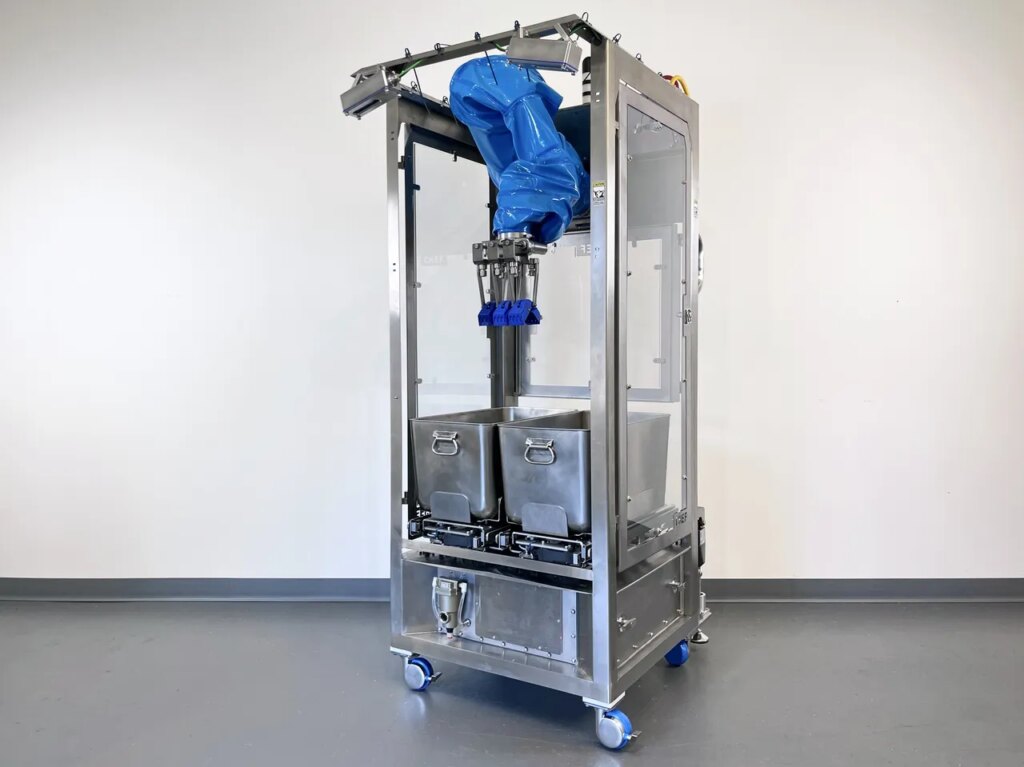
The robot arms can be swapped out with fittings to handle around 70 different ingredients. They can also be a little sloppy. The arms reach down like claw machines into trays of various scoopable foods, dropping big plops of potato salad into a specific section of each tray. They get their aim right most of the time, but still occasionally make a mess as they drop the food. One human volunteer has the job of wiping the bits of food off the trays before the meals are sealed and whisked away. On the ground is a scattering of frozen corn that will get swept up and discarded after the job is done.
Maybe it’s not elegant, but as one of the volunteers points out, the robots aren’t any messier than the humans.
“Food is weird,” Bhageria says. “It’s sticky, it’s malleable, it’s wet. Even the best simulation doesn’t completely get it.”
Having the robots doesn’t offset the need for volunteers, Hepfer says. He’s hopeful that by investing in this tech-forward experiment, Open Hand can make the case that it’s worth attention from the city’s monied interests. Maybe it could even encourage more people to volunteer.
“A lot of times people in the for-profit world think, ‘Oh, that’s a cute little nonprofit,’” Hepfer says. “I’m hoping that maybe the gravy on top of all this—the low-salt gravy on top—might be that people from the tech world might see that we are open to innovating and using technology and AI to improve the product we’re providing for people’s health.”
Joseph Sobiesiak, who now helps run the meal assembly line, had first come to Project Open Hand in need of its services in the early ’90s. “I didn’t die,” he says. “And so now I’m here as a way to give back.”
I ask how he feels about the robots. He seems skeptical at first, then shrugs and says he has come around, more or less.
“I’m old-school,” Sobiesiak says. “It’s working better than it did at first. Things are definitely much faster than before.”
The post These Robots Are Making Meals for a Nonprofit in San Francisco’s Tenderloin appeared first on Wired.