The best-seller list bows to Reese Witherspoon. Sarah Jessica Parker judged the Booker Prize. And Kate Hudson reared up recently in a New Yorker video praising Gabriel García Márquez’s “One Hundred Years of Solitude.”
But long before actors put the Botox in BookTok there was Marilyn Monroe, who might be celebrating her own hundred years on June 1, had her life not ended at 36 in a haze of barbiturates and jumbo tabloid type in 1962.
There is little new to say about her films or fashion. But what of her literary influence?
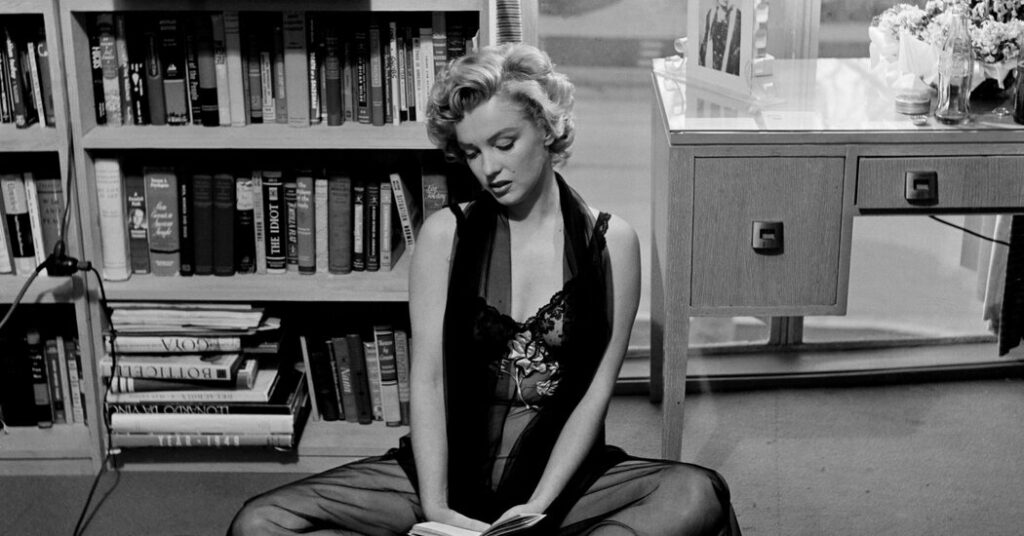
In MARILYN AND HER BOOKS: The Literary Life of Marilyn Monroe (Gallery, 290 pp., $30), Gail Crowther attempts to debunk Monroe’s dumb-blonde reputation through the Murphy door of her private library. (A few selections from which will be auctioned by Julien’s in June, along with the front gates to the house where she died — welcome, guests! — and a used pot of rouge that at this writing had already been bid up to $3,500.)
The star owned over 400 books, moving them with her from dwelling to dwelling. They range widely in genre, from “The Little Engine That Could,” by Watty Piper, possibly bearing her juvenile scrawl, to “Look Homeward, Angel” and other works by Thomas Wolfe, to Russian literature (she hoped to play Grushenka in a movie version of “The Brothers Karamazov”). There is a copy of “The Tales of Rabbi Nachman,” by Martin Buber — Monroe converted to Judaism when she married the playwright Arthur Miller — and four copies of Kahlil Gibran’s “The Prophet.”
Sensitive about not graduating from high school, Monroe studied world literature in an adult-extension program at U.C.L.A. “If you are ignorant, books won’t laugh at you,” she said poignantly.
As if to combat a public perception of ditziness, she was often photographed in the popular magazines of the day with her bobbed nose in a book, or browsing in a bookstore (where, according to Miller, a male customer once began masturbating as she was mouthing the words to some E.E. Cummings poetry). But she was rarely queried about her reading habits by journalists. Her eternal quest was for self-improvement, underscored also by the dumbbells she hoisted well before Jane Fonda made it fashionable. (A set is currently $1,250 at Julien’s.)
“It is worth considering that much of Marilyn’s reading was her attempt to ‘better’ herself,” Crowther writes, noting the absence of certain best sellers of the day in the collection. “If she felt a genre was not going to help with that, or worse still, if she would become a joke for reading it, then it may go some way to explain why she avoided it.”
It is refreshing to contemplate Monroe as reader, for as muse she has been stretched thinner than the diaphanous scarves in a Bert Stern photo. Someone so holographic is far more humanized by what was on her shelves than by some rotten rouge or the moth-eaten, Kardashian-appropriated frocks from her closet.
Fact and fiction have mingled recklessly at least since 20th Century Fox changed her name from Norma Jeane Dougherty, the surname of her first husband. Her second husband was the Yankee center fielder Joe DiMaggio.
Her biographers have included, ignominiously, Norman Mailer (Pauline Kael’s pan of his effort, in these pages, is itself a classic) and, restoratively, Gloria Steinem. Her ups and downs, with emphasis on the salacious Kennedy overlaps, have been novelized by, among others, Joyce Carol Oates (“Blonde”), Michael Korda (“The Immortals”) and James Patterson.
The breakup of her marriage to Miller helped inspire his controversial play “After the Fall,” among the wide range of topics covered in THE ARTHUR MILLER TAPES: A Life in His Own Words (Cambridge University Press, 322 pp., $29.95), a new collection of interviews conducted over 30 years by Christopher Bigsby.
Miller himself hedged on the connection. “The play is really about the death of love, and how one walks away from that and still feels some grip on existence,” he told Bigsby. “To be sure, you wouldn’t know that from the way the play was handled in the press. But that is what it is about.”
The playwright did little to shore up Monroe’s intellectual reputation — newspapers referred to the couple as “the Goddess and the Genius” or “the Egghead and the Hourglass.” Indeed, he probably helped erode it.
“With the possible exception of Colette’s ‘Chéri’ and a few short stories,” Miller wrote in his 1987 memoir “Timebends” (well worth revisiting), “I had not known her to read anything all the way through.”
Crowther quotes this indignantly, but not Miller’s further comment in “Timebends,” that his wife disliked a story of Bernard Malamud’s for portraying rape, which she had experienced, without sufficient knowledge. Presaging the #OwnVoices movement, “she could not suspend her disbelief toward fiction, wanting only the literal truth, as from a document,” he wrote.
Yet writers of all stripes were unusually drawn to her. Monroe was friends with Dorothy Parker, a previous subject of Crowther’s, and had a soupçon of her wit, once telling a reporter, “Men seldom jump hurdles for girls who wear girdles,” and declaring, “I read poetry to save time.”
Carl Sandburg brought Monroe antique bronze wind chimes to hang around her pool. No great shakes in the kitchen (despite owning a stained copy of “The New Joy of Cooking” that eventually sold to a private collector for $29,900), she prepared for a visit from Dylan Thomas, according to her then-roommate Shelley Winters, by scrubbing lettuce leaves with a Brillo pad.
She dined on oysters and champagne with Carson McCullers and Isak Dinesen, who likened her to a lion cub; and summited with Edith Sitwell, who remarked that “in repose her face was at moments strangely, prophetically tragic, like the face of a beautiful ghost. A little spring-ghost, an innocent fertility daemon, the vegetation spirit that was Ophelia.”
In fact, Monroe had hankered for this role along with, at various points, those of Juliet and Lady Macbeth; read Cordelia opposite Anton Chekhov’s nephew Michael as Lear in an acting class; and even dreamed of mounting a Marilyn Monroe Shakespeare Festival.
“She showed an interest in intellectual subjects which was, to say the least, disconcerting,” remarked the acidulous George Sanders, who appeared with her in “All About Eve.” “She was somebody in a play not yet written.”
Alexandra Jacobs is a Times book critic and occasional features writer. She joined The Times in 2010.
The post Some Like It Literary: How Marilyn Monroe Gave a Smart Gloss to Her Image appeared first on New York Times.