Most years, when thousands of psychiatrists gather for the annual meeting of the American Psychiatric Association, they walk past a scattering of protesters. There are Scientologists with megaphones; Falun Gong groups doing their exercises; and, often, former patients, saying they have been harmed by medications or electroconvulsive therapy.
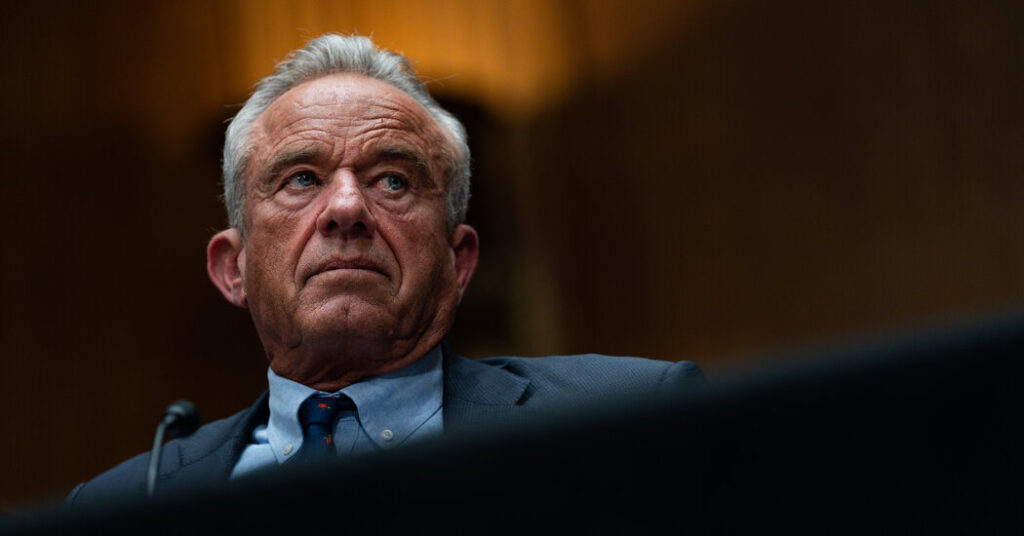
This year, though, the profession is facing criticism from the highest levels of the federal government. The American Psychiatric Association gathered just 10 days after Health Secretary Robert F. Kennedy Jr. announced a set of policies to encourage doctors to deprescribe, or assist patients in stopping, the most widely prescribed class of antidepressants.
A current of anxiety ran through the meeting, held here this week. Many physicians in the crowd said they worried that Mr. Kennedy’s statements would prompt people to refuse medications, or to quit them and relapse. The plenary session erupted in applause when Dr. Marketa Wills, the organization’s chief executive, declared, “We will never support governmental interference in the practice of medicine.”
“We are standing tall for evidence-based care,” she continued. “We are standing tall against stigma, oversimplification, and anything that would move patients further away from the care that they need.”
But there were also signs that the field’s leaders are engaging, albeit cautiously, with Mr. Kennedy’s effort to curb overprescribing. Numerous sessions offered training in helping patients taper off medications. In July, the association’s president will take part in a panel convened by the Department of Health and Human Services to develop clinical guidance on tapering antidepressants.
In an interview, Dr. Wills said she had been “encouraged” by the invitation to participate in the panel, and she credited the administration with “putting mental health front and center.”
“It feels like the beginning of a conversation, one that we welcome,” Dr. Wills said. She added, “It would be odd to have that conversation without psychiatrists at the table.”
Outside in the corridors, some rank-and-file attendees were less diplomatic.
Many providers took issue with Mr. Kennedy’s negative characterization of selective serotonin reuptake inhibitors, or S.S.R.I. s, the most widely prescribed class of psychiatric medications. Clinical trials have found that most patients’ depressive symptoms improved with S.S.R.I.s, and they are considered safe enough to be prescribed by general practitioners.
A 2026 study found that 16.6 percent of U.S. adults, or roughly one in six, reported currently taking an S.S.R.I.
“He just doesn’t like S.S.R.I.s,” said Dr. Sung Hyon, a psychiatrist from Pasadena, referring to Mr. Kennedy. Dr. Hyon said S.S.R.I.s had been “foundational” in his practice — “boring drugs that are well established, have good safety evidence and have zero chance to cause addiction.” He called them “God’s gift to psychiatry.”
And patients know it, he added. “So many millions” of Americans already take S.S.R.I.s, he said, and the vast majority are fully aware of their downside, like sexual side effects and withdrawal symptoms.
“And they say, ‘You know what? It’s worth it,’” Dr. Hyon said. “Because there are so many of them, it would be a pretty big political firestorm if he really tried to restrict access. And there is very, very little medical evidence to do so.”
Mr. Kennedy has long signaled that curbing the use of psychiatric drugs was a goal of his. Earlier this month he began taking steps in that direction, announcing guidelines and regulatory changes meant to provide an incentive for clinicians to help patients taper off psychiatric medications. The steps would not affect patients’ access to antidepressants.
Andrew Nixon, a spokesman for the Department of Health and Human Services, said the agency had had no discussions about banning S.S.R.I.s., “and any claims suggesting otherwise are false.” The aim of the new initiative, he said, is to “promote appropriate psychiatric prescribing and drive deprescribing when clinically indicated.”
Some psychiatrists said they worried that Mr. Kennedy’s deprescribing initiative was the beginning of a wider effort that might, in later stages, discredit psychiatry more broadly and restrict access to care.
“I think it is actually putting more questions in people’s minds about whether psychiatric treatment is safe or effective,” said Dr. Eric Rafla-Yuan, who chairs the A.P.A.’s caucus on the social determinants of health. “The data has not changed on S.S.R.I.s. It’s the narrative that has changed.”
He said the A.P.A. should be pushing back forcefully against Mr. Kennedy’s claims about psychiatric treatments, and should steer clear of seeming to endorse any part of the initiative.
“It’s a fine line between having a seat at the table and being used as a tool to legitimize their agenda,” he said.
‘Much Too Medicated’
At the same time, deprescribing seemed, at the meeting, to be on everyone’s lips. A new book, “Stahl’s Deprescriber’s Guide,” was selling like hot cakes in the exhibition hall. There were panels titled, “Deprescribing Antipsychotics,” “The Much Too Medicated Patient” and “Stimulants for A.D.H.D.: Did We Get It Wrong?”
Dr. Chris Aiken, who delivered an address about multidrug cocktails, said a generational change is moving through the psychiatric association, as a younger cohort of physicians, in their 30s and 40s, take a more prominent role.
Millennials were part of the first generation to be prescribed stimulants and antidepressants as children and teens, he said, and physicians in that group are more conscious of poor outcomes years later. “Meds are not the answer, and they have seen this in their own lives,” he said.
Some senior physicians had a similar message.
“If I have any regrets about my recommendations as a physician, it’s about the medications that I did not withdraw sooner,” said Dr. Ronald Winchel, an assistant clinical professor of psychiatry at Columbia University’s medical school, at one panel.
He said a number of concerns had prevented him from doing so: Sometimes, patients were taking multiple medications and it was difficult to say which was effective. Sometimes, patients were doing well, and he was afraid of setting them back. And there was a dearth of research on how patients do after they quit medications.
“The fear of withdrawing medications has really complicated our work,” he said.
Dr. Winchel compared this year’s churning discussion to a watershed moment in the A.P.A.’s history: In 1973, sustained pressure from protesters caused the organization to reverse its century-old position and declare that homosexuality was not a mental disorder.
“Instead of getting into a defensive crouch, they looked at themselves and they made progress,” Dr. Winchel said. The same kind of advancement, he added, could result from a rigorous discussion about prescribing practices. “If some of this agitation is coming from outside,” he said, “what is wrong with that?”
In his presentation, Dr. Aiken urged colleagues not to dismiss the stories Mr. Kennedy has highlighted of patients who have encountered serious difficulties quitting antidepressants.
“I don’t really know how common it is, but I do know that when it does happen, it can be quite severe,” he said. “It may be rare, but let’s take it seriously, because it can really burn people when it happens.”
Others said working with Mr. Kennedy around mental health policies was a matter of simple pragmatism.
“There’s definitely a need for us to be talking to the people who are making decisions,” said Dr. Hammad Khan of Sacramento. “We can’t let Joe Rogan decide what the F.D.A. approves or doesn’t approve.”
An Inflection Point
Dr. Awais Aftab, the author of “Psychiatry at the Margins,” a popular mental health Substack, said he expects the H.H.S. effort to focus on raising awareness about tapering off medications. There are few pathways for the government to reduce the prescription of drugs like S.S.R.I.s, which have gone through F.D.A.-approval pathways and are widely used by the public, he said.
He described “a sense of alarm” among psychiatrists at the virulent critique of the field coming from Mr. Kennedy’s circle. Psychiatry, he said, has been late to acknowledge the complaints of patients like Laura Delano, an author and activist, who say they were overmedicated as children or teenagers and got little support from doctors when they wanted to reduce or stop the drugs.
“The mainstream psychiatric community has been fairly insulated, and suddenly they are hearing now about this issue,” said Dr. Aftab, a psychiatrist at Case Western Reserve University.
He added that he believes that the use of antidepressants in the United States may have reached a natural limit. “The demand is going to, at some point, go into an equilibrium with the reality of the lack of effectiveness and the reality of the tolerability issue,” he said.
But the experience of some other countries suggests that the demand for antidepressants may continue to rise, even amid warnings about overprescribing.
In 2017, Britain commissioned a major report on overprescribing and then followed up with a series of reforms, including updating clinical guidelines to require regular prescribing reviews and instituting a national audit program to monitor drug use.
But a study of prescribing in Britain found that the use of antidepressants continued its steady rise through 2023, the last year for which data was available. In contrast, recent years have seen a decline in the use of anxiety medications and hypnotics, which were also the subject of updated clinical guidelines.
The study’s authors said the rise was most likely driven by patient demand, reductions in stigma and the lower cost of antidepressant medications available in generic form.
Many psychiatrists at the conference in San Francisco said that they routinely urge patients to try therapy as an alternative or a complement to medications, but that many patients have no access to that care, because their insurance will not pay for it.
Dr. Michael Bostwick, a suicide researcher and professor of psychiatry at Mayo Medical School, in Rochester. Minn., said it remained unclear what alternative treatments Mr. Kennedy is recommending to patients who quit antidepressants.
“Toward what end?” he said. “Is he going to put more resources toward therapists? Is he going to tell us to eat more red meat, or work out more, or take psychedelics, like the president has advocated? There is no alternative plan.”
Ellen Barry is a reporter covering mental health for The Times.
The post Kennedy’s Push to Curb Antidepressants Has Shaken Psychiatry appeared first on New York Times.