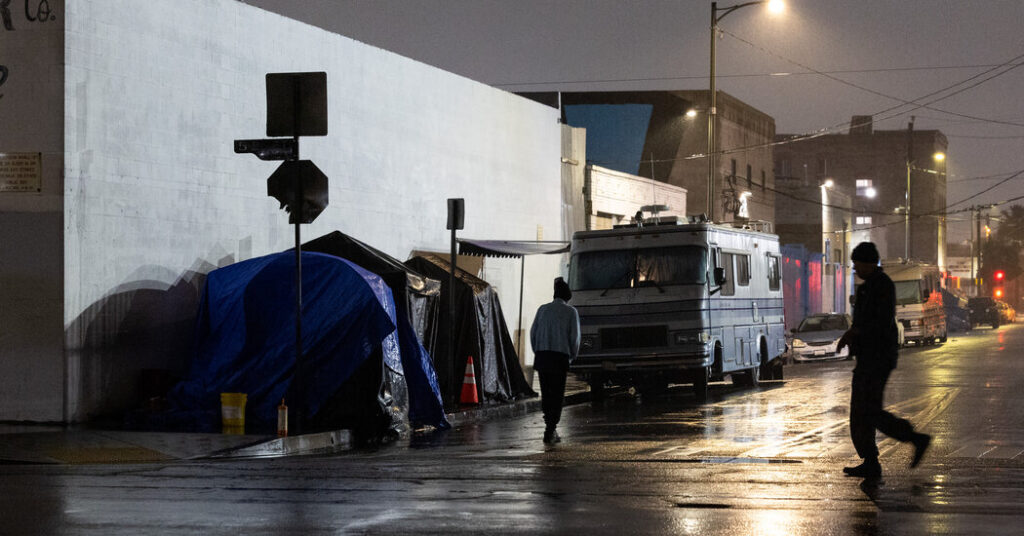
On any given night in California, estimates suggest, roughly 34,000 homeless people will take shelter in their vehicles. Tori Larett, a homeless rights lawyer in Sacramento, thinks the real number is double that. For half of them, their home is a recreational vehicle, converted bus or travel trailer parked on the street.
In January, a new California law went into effect in Los Angeles and Alameda Counties, allowing the authorities to quickly demolish oversize vehicles worth up to $4,000, up from $500, if the owner cannot move the vehicle without help from a tow truck.
“The whole state is waging a war on R.V.s right now,” said Ms. Larett, who is also the research director at the National Vehicle Residency Coalition.
For three cloudless days in March, Sam Lutzker and I crisscrossed Los Angeles hearing stories about life in R.V.s. Mr. Lutzker, 33, has weeks left before three years of field research for a Ph.D. in sociology at U.C.L.A. gives way to writing his thesis. “I care about these individuals deeply,” he said.
The center of his field work is City Council District 11 in Los Angeles, where Councilwoman Traci Park spearheads towing sweeps. When R.V.s are removed, she publishes social media posts about her success cleaning the streets. Local businesses and residents organize against oversize vehicles and sometimes hire private security companies to press R.V. dwellers to move — even when the vehicles are legally parked.
Ms. Park describes R.V. dwellers as living in mile-long encampments of dilapidated “nuisance vehicles” where crime and unsanitary conditions are rampant. “There’s widespread illegal dumping, including of human waste,” she said. “These encampments are a public health emergency, a public safety emergency.”
Mr. Lutzker, whose study includes about 90 people living in vehicles, places the population along a spectrum that includes economic hardship, drug abuse, personal trauma and a deliberate choice to live outside conventional housing. He said many were scattered solo or in small groups on side streets, not in encampments.
Mr. Lutzker acknowledges it’s a problem when homeless people live in unsafe R.V.s, but he disagrees with a regulatory approach that tickets, impounds and destroys vehicles — sometimes with the owner’s possessions still inside — without providing services to their owners.
“There is currently a two- to three-month wait to be assigned a case worker to help you get into a shelter,” he said. The people who are unable to move their vehicles are the poorest and most vulnerable. “A lot of these operations will force, like, 15 R.V.s to move. They know they’re not going to get all those R.V.s,” he said. “They’re doing it for the three or four that are left over.”
Advocates say R.V.s are seen as an eyesore — the most visible sign of California’s homelessness crisis. Neighbors and politicians want them gone. “It comes down to aesthetics,” said Ms. Larett. “Compassion fatigue around unsheltered homelessness in California has never been higher.”
I was riding shotgun as Mr. Lutzker turned the corner onto the industrial side street behind Google’s Los Angeles office in the Venice neighborhood. I counted five oversize vehicles, including a 27-foot pale-yellow school bus. That’s where we met its owner, Chanel Lara, 29, a Fresno transplant.
Ms. Lara came to Los Angeles to avoid the oppressive heat in the Central Valley and to escape poverty. Her family relies on welfare, she said, adding, “Why not go somewhere where I have more opportunity?” Five years ago, Ms. Lara drove to Los Angeles in a Nissan Maxima, even though it meant sleeping in it. The Maxima broke down, becoming a “metal tent,” she said.
Since then, Ms. Lara has lived in various vehicles while working “soul-sucking” jobs in coffee shops and home care. She found her current home — the Freightliner school bus — through a Facebook group for “skoolies,” converted school buses used as homes, acquiring it for $3,500 including airfare to Washington State and the drive back. Her dream is to convert a mini school bus into a mobile salon selling her handmade spa products.
She’s a young Afro-Latina woman parked on West L.A. streets, where the romanticized “#vanlife” of social media — yoga mats, sunsets and spotless Sprinter vans — is valorized. “It’s cool when it’s a blonde doing it out of a Sprinter van,” she said. “The rest of us are homeless.”
One day four months ago, she returned from work to discover police officers and city staffers threatening to tow her bus. She climbed to the vehicle’s roof, dropped into the cabin through the emergency hatch and sped away.
For decades, Los Angeles has alternated between sweeping encampments and court-ordered restraint. In December 2022, Mayor Karen Bass began Inside Safe, a program to move people from encampments to hotels until permanent housing — which remains in short supply — becomes available.
After spending $300 million, the results are mixed: two years of declining street homelessness (though a RAND analysis suggests an undercount), offset by a 40 percent return to the streets among Inside Safe participants. R.V. dwellers are routinely promised housing in exchange for surrendering their vehicles. Those promises often don’t materialize, advocates say.
We headed north to Sherman Oaks, more suburban than Venice. David Boone, 71, a former limousine operator, has been living for nine months in a 2018 34-foot Heartland North Trail travel trailer pulled by a Ford Expedition. He’s parked next to a Mercedes dealership, which does a brisk business in selling high-roof luxury Sprinter vans.
Mr. Boone lost his home and his business in a divorce two decades ago. He takes part-time gigs as a driver and a security guard to make ends meet. A nearby bungalow apartment suited him until last June, when the building’s new owner announced plans to tear it down. “Rents are well over $2,000 a month around here,” he said. “I just don’t make money like that anymore.” He bought the well-appointed trailer for $16,000 from a used car lot. “I bought this, but I didn’t do my homework about what the city was allowing.”
Mr. Boone introduced himself to the Mercedes dealership’s general manager. “He didn’t really want to have any conversation,” Mr. Boone said. A police officer gave him an informal pass to stay for weeks without moving every 72 hours, but informed him after our visit that a sweep was coming and he should move. “It’s messing with my head,” he said. “I don’t want to live like this anymore.” He’s hopeful about a lead for a subsidized apartment but plans to keep the trailer. “This is plan B for me,” he said.
Mr. Lutzker and I spent an afternoon with Kathy Coates, 62, and Amir Edwards, 52. Ms. Coates has struggled with severe depression. Mr. Edwards wears hand-sculpted horns on his head so he can’t be misidentified by the police. He adopted the strategy, he said, after a security guard once accused him of a crime committed by another Black man.
After Ms. Coates received an inheritance from her mother, the couple rented an apartment in Mar Vista. When the money ran low and their $2,000 in monthly rent became onerous, she bought a used 1991 Ford Tioga motor home for $9,000.
They found their way to the Ballona Wetlands, where about 50 vehicles had gathered. Three months later, tow trucks arrived. The couple fled to a nearby street behind a Home Depot and then to Washington Boulevard, accumulating $4,000 in parking tickets. In June 2024, a vigilante threw a boulder through the back window of the R.V., and it landed a few feet from where Ms. Coates was resting. “That thing could have hit me in the head, and I would have been gone,” she said. “It was the scariest thing.”
Last May, the couple accepted $500 for their vehicle and a guaranteed path to housing.
After five months in a city-funded motel, they moved in October 2025 into Elderberry Village, permanent subsidized housing with on-site services. They feel relieved to no longer be living in an R.V., where they felt targeted. “All in all, I’m happy here,” said Ms. Coates.
The post In Homeless Crisis, California ‘Is Waging a War on R.V.s’ appeared first on New York Times.