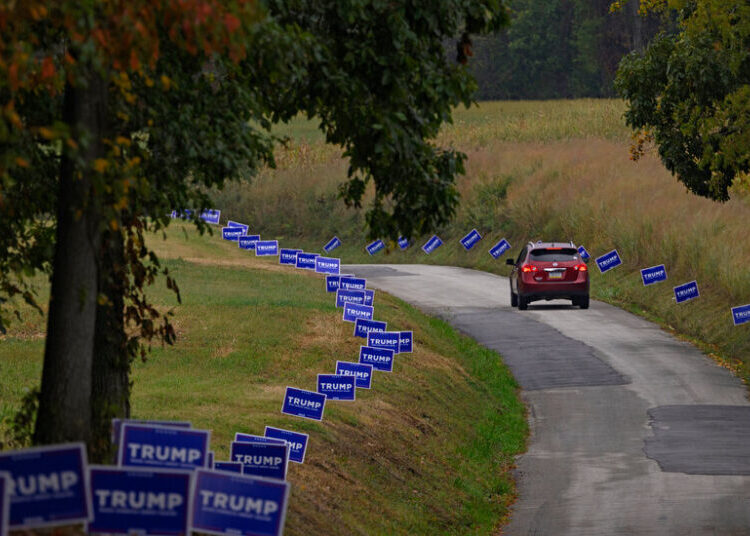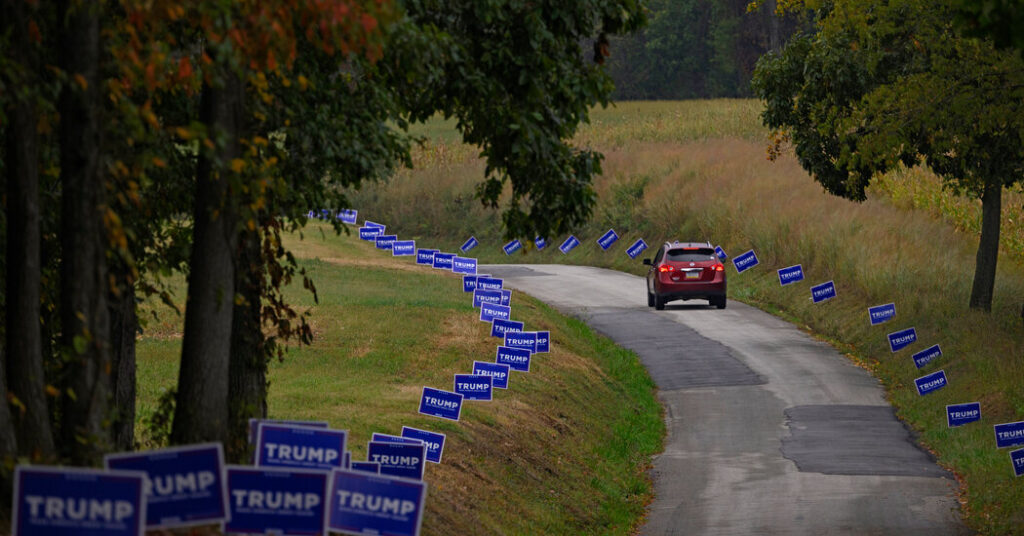
It is the most overused metaphor of Trump 2.0 (along, perhaps, with “Trump 2.0”). If you are worried that this administration has careened out of control — gutting the federal work force, threatening allies, starting wars, militarizing American cities, emasculating NATO, knocking down chunks of the White House, proposing that taxpayers foot the bill for a $1.8 billion political slush fund — then the failure of “guardrails” is your constant lament.
“Just imagine Donald Trump with no guardrails,” Kamala Harris warned late in her failed 2024 campaign. The guardrails are “made of Jell-O,” a host for MSNOW complained as he considered Trump’s first year back in office. And Democrats pitch all manner of legislation as essential “guardrails” around the powers and the personality of the 47th president.
What “norms” were to Trump’s first term, “guardrails” are to his second. We’ve gone from “Can he do that?” to “What can stop him?”
The problem is that guardrails — their presence or absence, their strength or deterioration — are a limiting way to imagine restraints on executive power. Even as they supposedly protect us from the overreach of our leaders, guardrails risk reducing the rest of us to spectators. A guardrail suggests that some trustworthy sage of long ago (James Madison is a favorite) has inspected the road and erected sensible boundaries. No need to worry; there’s a guardrail.
Except sometimes there isn’t; or sometimes it’s weak. Or sometimes the only way to make a guardrail go from metaphor to reality is to become one yourself.
Actual, physical guardrails exist to keep us from falling, like those on hospital beds or highchairs. They protect the vulnerable. We also see guardrails on the side of a highway or on a walking path near a cliff. Those are there to discourage recklessness, to warn us if we venture too close to the edge.
Of course, infants and old people still fall, and if someone wants to crash through a guardrail onto the median or hop over the railing and peer down that cliff, it’s not hard to do. If someone is heedless of danger or decides that normal calculations of risk don’t apply, then guardrails may not accomplish much.
While real guardrails are often made of metal or durable plastic, our democratic guardrails are made of less substantial stuff.
They are made of paper, as in constitutions, statutes and codes — things we write down.
They are made of ideas — those self-perceptions and habits of behavior that we absorb just by living here.
And they are made of flesh — the flesh of judges, lawmakers, prosecutors, advisers and voters, the flesh of citizens.
American history has shown, and the Trump presidency has reaffirmed, that while they are essential, guardrails alone can’t save us. Sometimes, we shred the papers, ignore the ideas or slice right through the flesh.
The ultimate paper guardrail in the United States is the Constitution, our owner’s manual. This one really is paper; you can visit the National Archives in Washington and see those four brittle and handwritten pages in a hermetically sealed case pumped with argon gas. (Yes, it’s a guardrail with its own guardrails.)
We know the main constitutional guardrails: powers split among the three branches of the federal government; the guardrails of federalism, that is, of powers shared between the states and the national government; and the Bill of Rights, which basically became a condition for skeptical state conventions to ratify the whole thing.
The verbs of the Constitution’s preamble burst with self-assurance — establish justice, insure domestic tranquillity, secure the blessings of liberty — but different passages cut in unexpected directions. For example, the stipulation in Article I, Section IV, that the “times, places and manner” of elections “shall be prescribed in each state by the legislature thereof” is a vital democratic guardrail when, say, an American president who has just lost re-election pressures state officials to “find” more votes in his favor. But how protective of democracy is this guardrail when those state legislatures gleefully redraw congressional districts so that politicians choose their voters and not the other way around?
Even the Constitution’s principal author was not sure that the document was adequate to the task before it. In Federalist 48, Madison wondered whether these mere “parchment barriers” were strong enough to sustain the Republic in the face of “the encroaching spirit of power.”
This singular piece of parchment has endured for more than two centuries and has come to be regarded as the sacred text of our civic religion. Tom Paine even referred to the Constitution as America’s “political bible,” and its most famous passages are often recited aloud, with devotional reverence.
But if we take seriously the notion of the Constitution as a sacred text of our national faith, we must remember that, within the world’s major religions, few things elicit greater controversies than the true meaning and interpretation of their sacred texts. Why should the Constitution be any different? In his 1988 book, “Constitutional Faith,” Sanford Levinson wrote that “a complacent use of the term ‘civil religion’ that ignores the ubiquity of religious division will be more often misleading than helpful as a tool of social analysis.”
Levinson then posed a challenge to his readers: If you imagine yourself a fervent constitutionalist — a supporter of all its guardrails, one might say — to which version of the American Constitution are you adhering?
Would you sign on to the first iteration, which did not name slavery yet still accepted it, the same Constitution that the abolitionist William Lloyd Garrison called “a covenant with death and an agreement with hell”? Or would you instead recommend the Constitution with the post-Civil War Reconstruction amendments, which abolished slavery and enshrined birthright citizenship, due process and equal protection of the laws? Or can you suffer the Constitution only as it stands today, with amendments expanding the right to vote to women, banning poll taxes and lowering the voting age to 18?
One more quandary: If you approve of the current Constitution because it has been sufficiently modified to your taste, how do you feel about binding future generations to a document that has become almost impossible to formally amend?
And like biblical verses, constitutional passages can be unclear. The Constitution does not define executive power, for example, and the current Supreme Court makes the most of that ambiguity. So, where exactly are the guardrails on the presidency when you have a lunging executive, a servile legislative majority and an unpredictably accommodating high court? If the path stays put but the guardrails move, are we still safe from the cliff?
There has been a standoff in recent decades over proper constitutional interpretation. On one side stands originalism (and its ne’er-do-well cousin, textualism); on the other is an evolving, so-called living Constitution. I’m partial neither to an originalist interpretation, with its overtly ideological intentions, nor to a living Constitution, with its almost vibes-based jurisprudence. More attractive is the notion of a “working” Constitution, as Jack Rakove put it in “Original Meanings,” his 1996 history of the Constitution’s beginnings.
Rakove wrote that “Americans have always possessed two Constitutions, not one: the formal document adopted in 1787-88, with its amendments; and the working Constitution comprising the body of precedents, habits, understandings and attitudes that shape how the federal system operates at any historical moment.”
This does not necessarily mean that the Constitution is becoming a wiser version of itself every day, but simply that the document becomes real when it encounters the world it means to govern. In Federalist 37, Madison seems to agree: “All new laws, though penned with the greatest technical skill, and passed on the fullest and most mature deliberation, are considered as more or less obscure and equivocal until their meaning be liquidated and ascertained by a series of particular discussions and adjudications.”
The law is obscure and equivocal until it is put in action, which means that our paper guardrails aren’t real until they are tested. You don’t really know how strong the railing is until something smashes against it.
In their 2018 book, “How Democracies Die,” Steven Levitsky and Daniel Ziblatt emphasize two political ideas — two guardrails — that are crucial to sustaining democracy: institutional forbearance and mutual toleration.
Politicians display institutional forbearance when they exercise restraint in the use of even their legitimate powers, not deploying them in full for temporary advantage, if only because someday a rival will come into power and do likewise. And mutual toleration means that politicians consider their opponents legitimate participants in the public arena, not existential enemies who must be vanquished at all costs.
When Levitsky and Ziblatt published the book, both guardrails were already under stress in American politics. Today, they’ve been overrun.
Mutual toleration has nearly vanished — politicians and supporters from one side see their opponents on the other as evil, as destroyers of all they hold dear. “If you don’t fight like hell, you’re not going to have a country anymore,” Trump said on Jan. 6, 2021, while Democrats invariably describe Trump as an “existential threat” to American democracy. Absent mutual toleration, the stakes are always at the highest pitch: National survival requires partisan victory.
Institutional forbearance has also deteriorated beyond recognition. The Department of Justice investigates and indicts a president’s political enemies and insulates the president and his family and businesses from tax inquiries. Immigration enforcement agents descend upon neighborhoods, workplaces and schools, detaining, raiding and even killing in the name of mass deportation. A self-styled Department of Government Efficiency takes a chain saw to the federal work force, eviscerating U.S. foreign assistance along the way. And a president is granted, via a generous Supreme Court, presumptive immunity for whatever “official acts” he commits on the job.
After all, why exercise forbearance when you finally wield the power to do what you’ve always wanted to do? When they get in the way of pet projects and partisan interests, high-minded ideas are easily disregarded by those in power. Consider Vice President JD Vance’s dismissiveness toward the American creed — he argues that people will fight for a place and a home, not for mere “abstractions” — even though the oath of office he swore was to defend the Constitution itself, that piece of paper so packed with abstractions.
The individuals who serve as democratic guardrails are those who uphold oaths, who challenge us to live up to our parchment barriers, who give all those other guardrails flesh.
One such flesh-and-blood American guardrail died recently, a man whose lengthy record in public life was unfairly downgraded during his final years. His name was Robert Swan Mueller III, and his case is illustrative of how we’ve come to regard constraints on presidential behavior, and on those tasked with investigating it.
Mueller served through national dramas and traumas. A Marine captain, he received a Bronze Star for valor in Vietnam. An experienced prosecutor and longtime Department of Justice official, he became director of the F.B.I. a week before the 9/11 attacks. And, of course, his last act involved serving as special counsel investigating the 2016 Trump campaign’s ties to Russia.
It’s difficult to overstate the fascination with which Washington, and the country, viewed Mueller during Trump’s first term. If you opposed the president’s policies or worried he had won office through murky means, Mueller and his crack prosecutors were there to bring it all to light. (“Mueller will save us” or “in Mueller we trust” were popular refrains.) If you were on the president’s side, Mueller was a nefarious agent of the deep state, a rogue prosecutor who had to be stopped.
He was portrayed on “The Simpsons.” Kate McKinnon played him on “Saturday Night Live.” The Washington Post cast Mueller and Trump as opposites: the war hero versus the draft avoider. Mueller was depicted by his admirers as trustworthy and principled, a dedicated truth seeker, above politics or partisanship.
He was an odd hero, and a stranger villain, for our time. But Mueller was never going to save us, no matter the touching faith of American liberals, nor was he out to destroy the president, whatever the conspiracy theories on the right. He was an old-school prosecutor; he wasn’t going to throw the book at Trump — he was going to go by the book.
Mueller saw and imposed limits on his own actions and on his purview, an act of institutional forbearance. Department of Justice guidelines dictated that he could not indict a sitting president, so Mueller wouldn’t and didn’t. He indicted plenty of Trump’s associates, winning guilty pleas and prison sentences. But the president was in a special category. (Recall that all the indictments of Trump, displaying their own greater or lesser degrees of forbearance, came during the Biden administration.)
Special counsels had abused their power in the past, so even as his team pursued leads and interviewed witnesses, Mueller stopped short in key areas. He did not dig into the president’s personal finances. He did not pursue a subpoena to interview Trump in person. And despite documenting Trump’s repeated efforts to interfere into the Russia investigation itself, Mueller’s 2019 report did not explicitly conclude that the president had obstructed justice.
Instead, the report featured some enigmatic lines that have become Washington lore. “If we had confidence after a thorough investigation of the facts that the president clearly did not commit obstruction of justice, we would so state. Based on the facts and the applicable legal standards, however, we are unable to reach that judgment.” (Read that again if you must.)
And here’s my favorite: “While this report does not conclude that the president committed a crime, it also does not exonerate him.”
The diffident nature of Mueller’s conclusions enabled William P. Barr, the attorney general during the second half of Trump’s first term, to publicly characterize the report as a vindication of the president, which it most decidedly was not. And suddenly Mueller went from hero to scapegoat. All the qualities that his admirers had effusively praised — that he stood for principle, that he would not bend the rules — became liabilities.
Analysts wrote that Mueller had “fumbled the moment,” that he remained “too invested in the norms of an institution of yore,” that his “institutional restraint” (forbearance alert!) had left his report vulnerable to competing interpretations. See how easily principles become anachronisms, how quickly we stop hailing proper procedures when they don’t deliver the preferred or anticipated results.
In his 2020 book on the Mueller investigation, “True Crimes and Misdemeanors,” Jeffrey Toobin, a Times contributing Opinion writer, captures the tensions in the lawman’s final act. Mueller’s faithful adherence to old values and codes “was both his greatest strength and his greatest weakness,” Toobin writes.
Mueller did not abdicate his responsibility. It is not, as Barr implied, that Mueller could not make up his mind about whether Trump had committed a crime. Mueller’s reasoning, as his own report stated, was that “a federal criminal accusation against a sitting president would place burdens on the president’s capacity to govern and potentially pre-empt constitutional processes for addressing presidential misconduct.”
With “constitutional processes,” Mueller seemed to nod toward the impeachment mechanism, expressing faith in the paper guardrail that is the U.S. Constitution. He didn’t give up; he left a path forward for Congress. If lawmakers chose not to walk it, that was neither his fault nor his responsibility.
Mueller, who had suffered from Parkinson’s disease, died in March, at age 81. Ever classy, Trump ghoulishly celebrated Mueller’s death in a social media post. “I’m glad he’s dead,” he wrote. “He can no longer hurt innocent people!”
But Mueller was demeaned in life as well as in death, and not just by the president and his supporters. The reinterpretation of Robert Mueller — from the man America needed to the man who failed America — is one of the quiet tragedies of the Trump era.
Different leaders are susceptible to different guardrails, and in the case of Trump they are not standard issue.
He fires administration officials when they make him look bad (Kristi Noem) or, in a sort of reverse guardrail move, when they don’t go far enough in abusing their power (Pam Bondi). When six lawmakers dare to remind members of the military and intelligence agencies that they are not obligated to follow unlawful orders, Trump seeks to have them prosecuted. He uses the presidency to enrich himself and his family. He doesn’t just avoid guardrails or skip over them; he actively tears them down.
Trump’s conduct of the war in Iran does not appear inhibited by the lack of allied support or congressional approval, or even by widespread public disapproval. The Dow Jones industrial average seems to be the poll that matters to him most. And when Times reporters asked Trump in January if anything could constrain his actions on the world stage, he responded that it was only “my own morality” and “my own mind.” (It’s the prefrontal guardrail.)
When the Senate Select Committee on Watergate issued its report in June 1974, Senator Sam Ervin of North Carolina, its chairman, wrote that no matter all the laws the committee was proposing, “law alone will not suffice to prevent future Watergates.” Paper needs people, and people are fickle. “Law is not self-executing,” Ervin explained. “Unfortunately, at times its execution rests in the hands of those who are faithless to it.”
To be faithful to paper guardrails, our leaders must adopt idea guardrails, too. They must “understand and be dedicated to the true purpose of government,” Ervin wrote, “which is to promote the good of the people, and entertain the abiding conviction that a public office is a public trust, which must never be abused to secure private advantage.” In effect, that they must exercise forbearance.
“When all is said,” Ervin concluded, “the only sure antidote for future Watergates is understanding of fundamental principles and intellectual and moral integrity in the men and women who achieve or are entrusted with governmental or political power.”
Note Ervin’s use of “entrusted” in that passage. Who entrusts our leaders with governmental or political power? We do, as voters and citizens. Popular sovereignty is embedded in the Declaration of Independence, which states that the government’s powers derive from “the consent of the governed,” and in the first line of the preamble to the Constitution, which asserts that “we the people of the United States” are the ones who ordain and establish the document.
Political accountability is necessary not just for our leaders but for ourselves, too. High office and political power bring responsibility, but so does popular sovereignty, which can be exercised in countless ways and places, whether in a Minneapolis street protest or in a midterm voting booth.
It is comforting to pine for guardrails, whether they are fashioned from paper, ideas or flesh. But constraining our leaders is not enough; the rest of us must be roused from the passivity that the very notion of guardrails might imply. The popular will is the most vital guardrail. We are not just arbiters of power, judging our leaders in elections and polls; and not just supplicants to power, hoping that our leaders will use it wisely and on our behalf. We also legitimize power; we exercise it.
Respecting a guardrail might mean staying in your lane. Becoming a guardrail means stepping out of it.
The Times is committed to publishing a diversity of letters to the editor. We’d like to hear what you think about this or any of our articles. Here are some tips. And here’s our email: [email protected].
Follow the New York Times Opinion section on Facebook, Instagram, TikTok, Bluesky, WhatsApp and Threads.
The post Guardrails Won’t Deter Trump. But You Might. appeared first on New York Times.