LONDON — With a U.S. naval blockade taking effect on Monday, oil prices again surging past $100 a barrel and a fragile ceasefire set to expire in nine days, the United States and Iran began the week locked in a standoff after historic peace negotiations in Pakistan collapsed over the weekend.
Washington, Tehran and anxious capitals around the world are not sure how a cascade of urgent questions will resolve: Will the bombing resume when the truce runs out on April 22? What will U.S. Navy operations in the Strait of Hormuz actually entail? And is there any conceivable path to an agreement on an Iranian nuclear program that has now survived not only two decades of international diplomacy seeking to curtail it, but also more than five weeks of the most intensive military assault ever launched against Iranian territory?
Financial markets were not reassured. Oil futures jumped above $103 a barrel as traders reacted to President Donald Trump’s announcement that U.S. warships would block traffic through the Strait of Hormuz. But just how tight a grip the Navy would impose remained unclear. U.S. Central Command declined to comment on how the blockade will be implemented.
Trump, in a Truth Social post Sunday, declared a sweeping embargo on “any and all Ships trying to enter, or leave, the Strait of Hormuz.” But U.S. Central Command implied a more limited blockade, saying it would begin stopping all traffic entering and exiting Iranian ports starting at 10 a.m. Eastern time Monday — early evening in the Persian Gulf. He told reporters Monday that the blockade had begun.
Pakistani officials were determined to keep the sides talking even after their abrupt departure from Islamabad on Sunday. Mediators emphasized that before the collapse, progress had been made on many issues during 21 hours of negotiations led by Vice President JD Vance and Mohammad Bagher Ghalibaf, speaker of Iran’s parliament.
Speaking at a cabinet meeting Monday, Pakistani Prime Minister Shehbaz Sharif said “full efforts” were ongoing to resolve the war.
“I don’t think the back-channel communication will stop. I think it will carry on — maybe not as we speak, but I was told it will not cease,” said Maleeha Lodhi, one of Pakistan’s most respected diplomats, who has served as ambassador to the United States, Britain and the United Nations.
But it was not clear what channels remained open as both U.S. and Iranian leaders quickly returned to their respective maximalist corners.
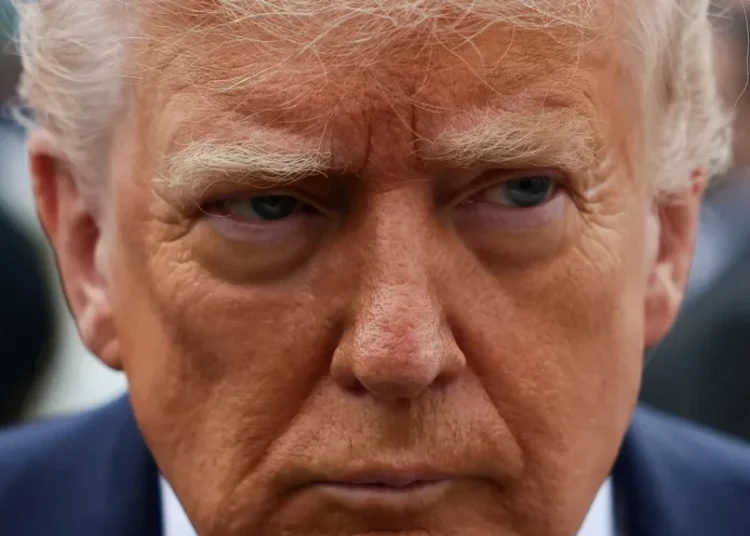
Trump expressed confidence that Iran’s bombed-out infrastructure and battered economy would still force its hand.
“I think Iran is in very bad shape. I think they’re pretty desperate. Iran will not have a nuclear weapon,” Trump told reporters Sunday. “I don’t care if they come back or not. If they don’t come back, I’m fine.”
Iran, for its part, showed no signs of feeling boxed in.
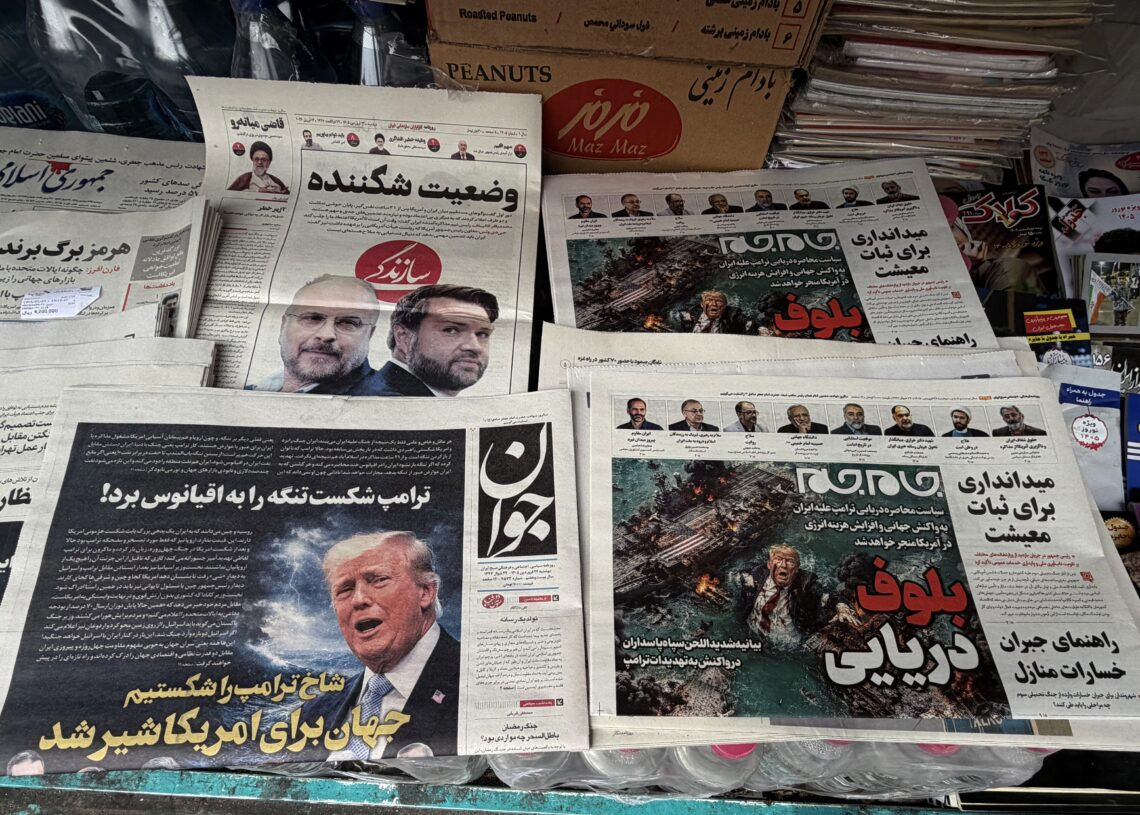
Commanders of the Islamic Revolutionary Guard Corps described the U.S. naval operations as “piracy” and threatened to target Gulf ports in retaliation. Officials projected the confidence of a regime that, so far, has weathered the worst that the world’s strongest military could deliver.
That perception of survival — despite widespread devastation and the assassinations of many high-level officials — has emboldened hard-liners in Tehran who argue the attacks by U.S. and Israeli warplanes have provided further proof of Iran’s need to develop the deterrent of a potential nuclear threat.
Israeli leaders, who publicly supported but privately regretted Trump’s ceasefire leading to the negotiations, quickly seized on the collapse of the talks to threaten a return to pounding Iran. Gen. Eyal Zamir, the chief of staff of the Israel Defense Forces, instructed the IDF to move to a heightened state of readiness and prepare for a possible resumption of hostilities.
Israeli Prime Minister Benjamin Netanyahu consulted with security officials in Tel Aviv on Sunday on the possibility of resuming the fighting in Iran, according to a person familiar with the matter who spoke on the condition of anonymity because they were not allowed to brief the media. “Israel must be prepared for any development,” this person said.
Lodhi said Pakistan’s diplomats feared the looming blockade could shatter the fragile truce. Trump may intend for the blockade to push Iran back to the negotiating table, but the operation also moves U.S. forces into much closer proximity to Iran.
“It will push the conflict to its most dangerous phase, because it will be up close and personal,” she said. “The Iranians are not going to just rush to the negotiating table since there is a blockade; they are going to respond militarily. They’ve said so.”
Analysts warn that the planned U.S. naval blockade, while well within the capabilities of the forces massed around the Persian Gulf, could face serious military obstacles. The narrow strait forces U.S. warships into a confined channel where Iran’s sea mines, shore-based missiles and swarms of cheap drones could diminish American military advantages.
Depending on how the Navy enforces the blockade, the U.S. could maintain a blockade in safer waters without deploying additional forces to the region, said Mark Cancian, a senior adviser at the Center for Strategic and International Studies. The Navy won’t have to intercept every ship, he said. Just searching or seizing 1 in 4 would send a message to shippers that there is a chance they will lose their cargo.
“I think they’ll do this outside the Gulf and strait and pick up ships as they come through,” Cancian said. “That’s probably enough to stop the vessels.”
The logic of the blockade, however, is straightforward: Cutting off Iran’s oil exports would sever access to the hard currency keeping its war economy afloat. So far, Iran’s own blockade of the passage has inflicted more damage to the world economy than to its own, as Iranian tankers have been able to pass the strait more frequently.
“One of the U.S. assumptions going into the war appears to have been that Iran would almost handicap itself by closing the Strait of Hormuz because a lot of its own hydrocarbons transit the same choke point, but that hasn’t happened,” said Sidharth Kaushal, senior research fellow for sea power at the Royal United Services Institute, a British military think tank. “In fact, the Iranians have exported more oil than they did before war, partially because Iranian oil is one of the few cargoes that have been able to safely transit the strait.”
The U.S. is looking to block Iran and to keep it from establishing permanent control of the strait, Kaushal said.
But the economic blowback could be double-edged: With roughly 7 million barrels of crude and 4 million barrels of refined product already trapped in the Gulf, blocking Iranian oil threatens to push global prices even higher. The strait is also a choke point for other supply-chain commodities, including aluminum, helium and fertilizer.
The effectiveness of the blockade has already been undercut by the United States’ lifting of sanctions last month on Iranian oil already at sea, a move the White House said was geared toward easing pressure on global crude markets. While the move was framed as providing little economic benefit to Iran, it has generated a windfall for the Iranian regime and is set to continue to do so with the blockade in place.
Ship-tracking data suggests there are roughly 100 million barrels of Iranian oil remaining at sea that can still be sold sanction-free until Sunday, according to Brett Erickson, managing principal at Obsidian Risk Advisors, which specializes in financial crime and regulatory issues. Most of that oil has moved out of the Strait of Hormuz since the sanctions were lifted and thus would not be impeded by the blockade.
As countries scramble to buy as much oil as they can amid a supply crunch that will be tightened further by the blockade, that Iranian oil is likely to sell at a premium. It could result in Iran generating at least $1 billion in revenue that it would not have seen if sanctions were still in place and Iran had to sell the cargoes at a deep discount.
The U.S. will meanwhile be under pressure from allies in Asia to extend the sanctions pause, which is set to expire Sunday, as they desperately need the Iranian oil at a time when other shipments through the Strait of Hormuz have been halted.
Such an extension, though, would further undermine the blockade. “This is a quagmire the U.S. is in where the options are basically let Iran pillage energy markets or expose the entire Asian continent to an increasingly untenable energy crisis,” Erickson said. “The clear lack of planning going into this conflict has left Washington with an impossible choice.”
In China, leaders worry that the U.S. and Iran are getting ready for an escalation over Hormuz, threatening more instability in the global economy and possibly forcing Trump to delay his much-anticipated summit with Chinese leader Xi Jinping next month, according to Chinese officials and scholars.
In the hours before the blockade was set to begin, Guo Jiakun, a spokesperson with China’s Foreign Ministry, urged all relevant parties to “remain calm and exercise restraint.”
The president’s public views on the shipping lane have vacillated, from his claim in a national address April 1 that the Strait of Hormuz did not matter, to his threat to obliterate Iran’s “entire civilization” if didn’t allow ships to pass, to now his imposition of his own blockade on the already blockaded passage.
Iran said it would strike back hard at the U.S. blockade.
“If Iran’s ports are threatened, NO PORT in the region will be safe,” the Iranian military central command said in a post on X on Monday.
But some experts said the U.S. blockade could effectively push Iran and its oil-dependent allies into a more conciliatory position and was preferable to deploying ground troops to disrupt Iranian exports by occupying key facilities, such as the processing and shipment facilities on Iran’s Kharg Island.
“The blockade always made more sense than seizing Kharg Island,” longtime U.S. diplomat Dennis A. Ross said in a social media post. “It stops Iran’s exports, its revenues, is a counterpoint to their closing the Straits. They may attack Gulf oil facilities but it puts greater pressure on Iran. It also puts great pressure on China to pressure Iran.”
Still, a new petro blockade risks inflicting deeper pain on Trump’s Asian allies than on China, partly thanks to the latter’s aggressive push in electric vehicles, which reduces its vulnerability to oil shocks, said Liu Zongyi, a researcher at the Shanghai Institutes for International Studies, a government-affiliated think tank.
Trump on Sunday threatened China with “staggering” 50 percent tariffs over allegations that it has provided military assistance to Iran. Some China hawks, including former ambassador to the U.N. Nikki Haley, called on Trump not to go to Beijing in May until China stops helping Iran.
Guo, the Foreign Ministry spokesperson, dismissed the military assistance accusations as “groundless smearing and malicious association,” saying that Beijing has always been “cautious and responsible” over arms exports.
So far, neither side shows signs of budging from core positions, particularly on the issue of Iran’s determination to maintain the nuclear research that it says is intended for legal civilian applications but that Israel and the U.S. insist is destined to provide Tehran with a nuclear weapon.
“The meeting went well, most points were agreed to, but the only point that really mattered, NUCLEAR, was not,” Trump wrote in a post Sunday.
In some ways, Trump now finds himself needing the same thing President Barack Obama needed in 2013, when he and Iranian President Hassan Rouhani started the long negotiations that yielded the 2015 international agreement on Iran’s nuclear program. Trump discarded that agreement during his first presidential term but now finds himself, like Obama, seeking to constrain nuclear ambitions that seem to have proved impervious to sanctions and military force.
In withdrawing from the agreement, Trump sided with Netanyahu’s view that the deal was allowing Iran to make clandestine progress toward a bomb. In its place Trump instituted a program of “maximum pressure,” a slate of punishing sanctions meant to force Iran to give up its enrichment program. In 2025, the U.S. and Israeli launched military strikes that badly degraded Iran’s deeply buried nuclear facilities.
Supporters of the negotiated deal say the military approach has only strengthened Iran’s commitment to obtaining an atomic weapon. Meanwhile, the two military campaigns have left 440 kilograms (about 970 pounds) of highly enriched uranium in tunnels that remain at least partially intact, their exact location unknown even to international inspectors. The stockpile is now harder, not easier, to account for, experts say. Supporters of the 2015 accord contend that Iran’s nuclear program was largely contained and closely monitored when Trump inherited the nuclear file from Obama.
“It’s rare that we’re given, in real time, historical counterfactuals that allow you to compare different methods of dealing with any problem, let alone one as difficult as Iran nuclear program,” said Rob Malley, who was a lead negotiator on the 2015 Iran nuclear deal. “We had diplomacy, we had maximum pressure sanctions, and we had the military. Of the three, I think it’s hard to dispute that the first was the most successful.”
George reported from Islamabad, Pakistan. Shaiq Hussain in Islamabad; Lyric Li in Tokyo; Mohamad El Chamaa in Beirut; Lior Soroka in Tel Aviv; and Tara Copp, Emily Davies and Evan Halper in Washington contributed to this report.
The post U.S. imposes naval blockade as Trump demands Iran end nuclear program appeared first on Washington Post.