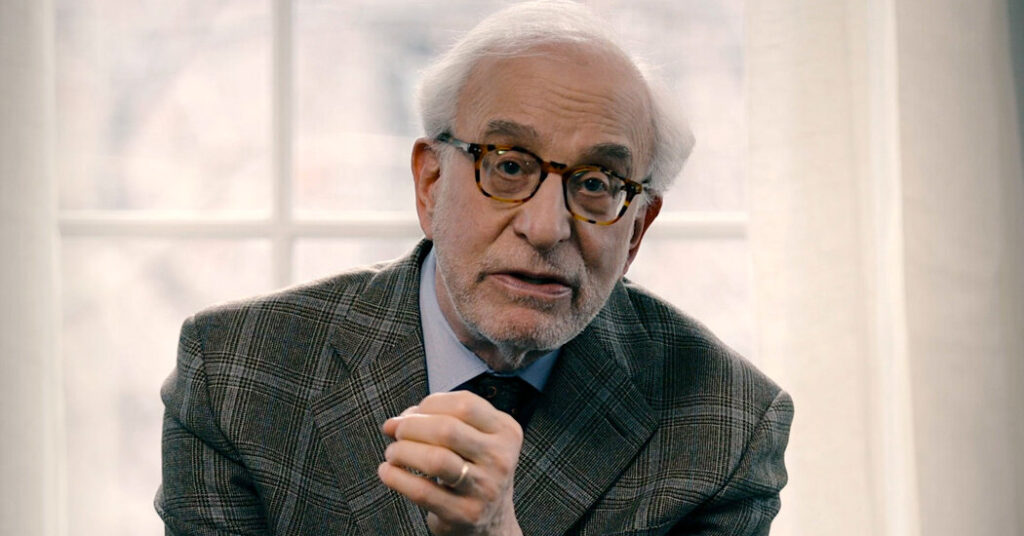
Except briefly at the beginning and end, “Group: The Schopenhauer Effect” is set entirely in one room, and it consists of three group therapy sessions that unfold in a semblance of real time. For readers to get the most out of the film, a critic ought to, in psychotherapy parlance, hold something back.
That something is the method in which “Group” was made. The simulation is persuasive enough that it’s possible, in moments, to convince yourself you’re watching real people share details about their lives. But (warning — conceptual spoiler) what you are seeing isn’t that.
The group’s leader, a doctor called Ezra, is played by an actual psychoanalyst, Dr. Elliot Zeisel, presumably responding as he would in his practice. The patients are played by actors, improvising from scripted outlines that the writer-director, Alexis Lloyd, based on his experiences in one of Zeisel’s groups. Most of the cast, including Zeisel, appeared in an earlier web series, which offers a taste of the movie without the momentum.
And yet: Does knowing that “Group” is dramatized detract from the value of watching these sessions, which are absorbing in the way a good stage play might be (with the added intensity of close-ups)? Does it matter that a new patient, Alexis (Thomas Sadoski), sticks out as an obvious surrogate for the filmmaker? That some developments — Manny (Bernardo Cubría) unrequitedly pines for Pam (Lucy Walters) — have the feel of manufactured conflict?
In a sense it doesn’t. It’s invigorating to watch these interactions, even if similar filmmaking methods have been used before. (See Leigh Ledare’s excellent “The Task,” from 2017.) The bombshell that Ezra drops in the second session gets at something genuine about the bonds that can form in a group like this. By that point, viewers might feel attached as well.
Group: The Schopenhauer Effect Not rated. Running time: 1 hour 59 minutes. In theaters.
The post ‘Group: The Schopenhauer Effect’ Review: The Art of Being Patient appeared first on New York Times.