The Supreme Court’s decision to invalidate many of President Trump’s tariffs threw into doubt a series of trade deals that the administration struck in recent months, including with the some of the country’s largest trading partners.
Many of the agreements had set tariffs at around 15 or 20 percent, lowering what would have been steeper duties in exchange for favorable trade concessions and promises to invest in the United States.
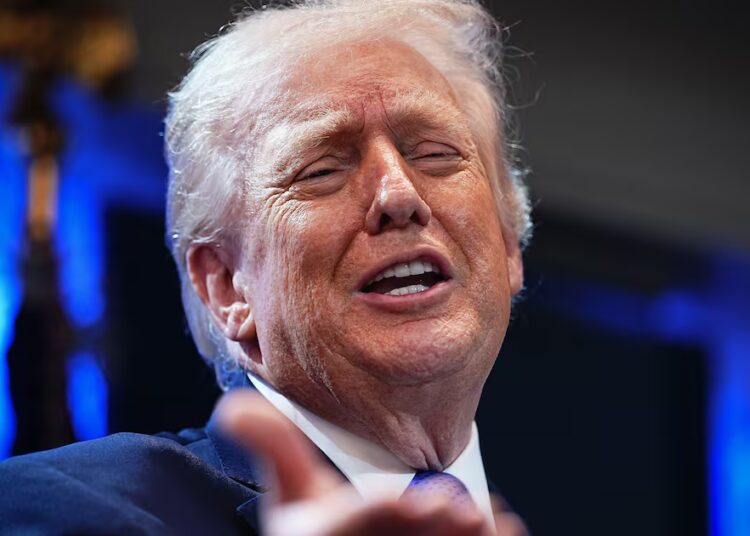
Asked about the status of the deals during a news conference after the decision on Friday, Mr. Trump said some of the agreements would stand, though he did not elaborate further. He also announced a 10 percent global tariff under a different legal authority — one focused on balanced trade deficits that no president had invoked in its half-century history.
Here’s a look at some key countries and regions that have made deals.
China
China in many ways has been the principal target of Mr. Trump’s trade war.
China’s exports to the United States are subject to a range of tariffs imposed under different legal grounds. For the most part, the United States treats these separate duties as stackable, so they can add up for some products to a considerable tariff burden.
The Supreme Court’s decision peels back some layers of the stack, including a 10 percent general tariff and a 10 percent tariff for failing to prevent fentanyl and related chemicals from flowing to the United States.
Other layers remain. These include 100 percent tariffs on Chinese electric vehicles and tariffs of 50 percent or more on many steel and aluminum products.
When Mr. Trump and Xi Jinping, China’s top leader, met in South Korea in late October, they agreed to extend a pause on additional tariffs that the United States had planned on many goods, including some electric motors and surgical equipment. Mr. Trump plans to travel to China in late March to meet with Mr. Xi.
The duties already in place have had a significant impact on China’s exports to the United States, causing them to drop by about a fifth last year. China has ramped up its sales instead across Southeast Asia, Africa, Europe and Latin America.
Many Chinese companies now do the final assembly of goods for the American market at factories in Southeast Asia or Latin America and sometimes in Africa as well. This has allowed them to bypass Mr. Trump’s tariffs on goods coming straight from China.
European Union
Last year, the European Union struck a deal with the United States that would cap tariffs at 15 percent and included an agreement for Europe to buy $750 billion of American energy and increase investments in the United States by $600 billion.
But the deal hasn’t been fully carried out yet and was partly delayed by Mr. Trump’s threats to hit several European countries with higher tariffs in his bid to gain control of Greenland last month. Lawmakers in the European Parliament had been expected to take another step toward approving the bloc’s side of the deal in a vote next week.
On Friday, the Federation of German Industries, a powerful business lobby, called on the European Union to quickly approach the Trump administration to clarify how the court decision would affect their trade deal, arguing that companies need reliable trading conditions as soon as possible.
Canada
The Supreme Court decision affects very few of the tariffs the Trump administration has imposed on Canada. Most of the tariffs on Canadian exports to the United States are the sectoral tariffs on goods such as steel and aluminum, which are not covered by the decision. And some 90 percent of Canadian exports are tariff-free right now under the United States-Mexico-Canada trade agreement.
Still, Canadian leaders were worried that a ruling against Mr. Trump would make him apply different types of tariffs that could affect Canada more, just months before a fraught review of the free-trade agreement among the United States, Canada and Mexico is due.
Mexico
More than 80 percent of Mexico’s exports are already exempt from duties under the North American trade agreement.
Friday’s ruling, however, changes nothing for other levies on goods from Mexico, which is the top buyer of U.S. goods and the leading exporter to the United States. Steel, aluminum, copper, heavy trucks, softwood lumber and wood products are all still subject to industry-specific duties.
Southeast Asia
Southeast Asia had everything to lose last spring when Mr. Trump threatened tariffs that were among the highest in the world. So while the Supreme Court’s decision will raise many more questions than answers about what happens next, it could at least provide some relief.
The region is America’s factory floor for sneakers, furniture and garments, winning out over China in recent years as global companies moved their manufacturing bases into Vietnam, Cambodia and Indonesia to avoid steep new tariffs on Chinese goods initiated during Mr. Trump’s first presidency.
Mr. Trump initially threatened tariffs as high as 49 percent for Cambodia, 46 percent for Vietnam, 36 percent for Thailand and 32 percent for Indonesia. He pulled back over the summer, announcing trade deal frameworks that settled on rates of around 19 percent.
On Thursday, Indonesia signed a trade deal with the United States, making it the third country in Southeast Asia to agree to new tariffs, along with Malaysia and Cambodia.
South Korea
In October, the South Korean government reached an agreement with Mr. Trump for tariffs of 15 percent — down from the 25 percent initially imposed. In return, South Korea committed to investing up to $350 billion in the United States. But much of the investment would be phased in over time at $20 billion a year.
SK Hynix and Samsung, South Korea’s memory chip giants, have both said they will invest more in U.S. operations. But last month, Mr. Trump said he would put the tariffs back to 25 percent to punish South Korea for taking too long to ratify the deal. In response, South Korean officials said that they were working to enact a plan to manage the $350 billion investment fund, but that political bickering in Seoul had slowed their progress.
Japan
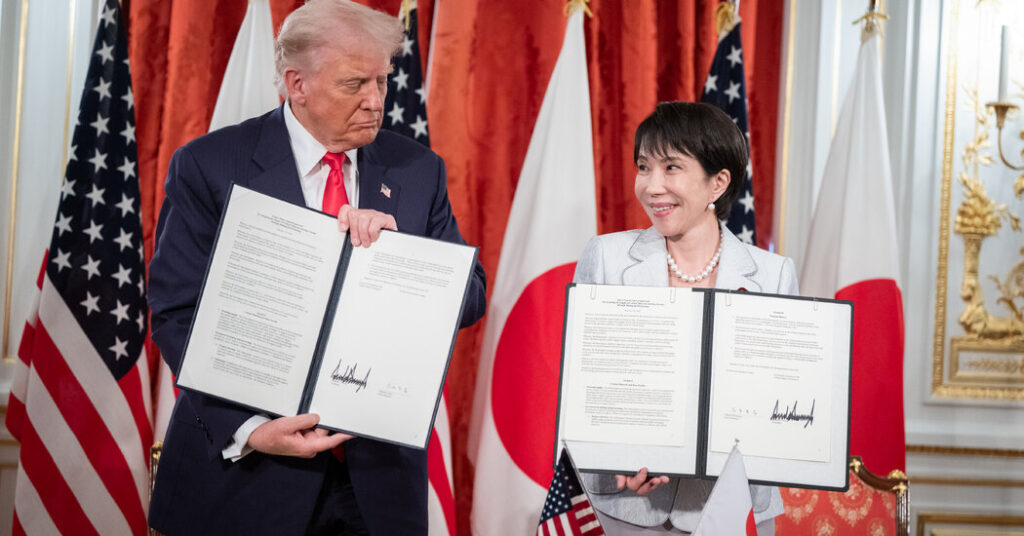
Last year, Mr. Trump threatened Japan, America’s top ally in Asia, with tariffs as high as 35 percent. Under the terms of a framework completed in July, Tokyo agreed to fund $550 billion worth of projects in the United States. In return, Washington agreed to a 15 percent blanket tariff on Japanese exports, which remains a point of contention.
The terms of the agreement, however, appeared particularly lopsided after South Korea later secured a deal with a looser commitment to spend $350 billion over 10 years.
Even before Friday’s Supreme Court decision, however, Japanese officials saw little room to renegotiate the nation’s investment pledges. To sell the Japanese public and other stakeholders on the “fairness” of the deal, Tokyo framed the agreement as a series of “win-win” projects.
The first batch of investment commitments by Japan, totaling $36 billion, were announced this week. Almost all of the money is slated for the construction of a natural gas power plant in Portsmouth, Ohio.
India
With a deal, Mr. Trump ended a 50 percent punitive tariff on India on March 2, imposing an 18 percent levy instead. But the agreement between the countries left many open questions. Mr. Trump said India had agreed to stop buying Russian oil, something he has been demanding since last summer. There is evidence India has been reducing its purchases of Russian oil, but it has not confirmed that it will stop entirely.
There are other tricky issues. India has committed to buying $500 billion worth of American goods within five years, in effect doubling India’s imports from the United States. The U.S. side has made it clear that it wants American agricultural exports to be on India’s shopping list — a delicate issue in India, where farmers are a powerful social force that has long expected protection from trade.
Taiwan
On Feb. 12, the United States and Taiwan completed a deal that had been announced in January after months of negotiations. The deal secured commitments to invest $250 billion in semiconductor and technology manufacturing in America in exchange for lower tariffs.
Taiwanese officials worked to extract a lower tariff rate of 15 percent over six trips to Washington.
The United States overtook China as Taiwan’s largest export market in 2024. But by value, only a small portion of Taiwan’s exports have been subject to the tariffs now struck down by the Supreme Court. These include plastic, textile and agricultural products.
Taiwan’s main exports — computer chips and electronic components — have been spared tariffs under an electronics exemption established in April.
Britain
Britain had the distinction of being the first country to sign a trade agreement with Mr. Trump last year, helping to set the standard for other countries’ negotiations. While the British government has frequently cited the success of this deal — which reduced tariffs on British car exports and set a base-line additional 10 percent tariff on most other goods — several aspects of it have still been bogged down in negotiations. Britain wants lower tariffs on its steel exports, while the Trump administration is pushing for Britain to accept more agricultural imports and is frustrated with the country’s digital services taxes and regulations.
The British government described the Supreme Court ruling as “a matter for the U.S. to determine” but added that it would “continue to support U.K. businesses as further details are announced,” a spokesperson said.
Most of Britain’s trade with the United States is in services, but about 40,000 British companies export goods to the United States. Michelle Ovens, who runs an organization representing small businesses, said the Supreme Court decision could indirectly help British businesses by easing the pain American buyers faced importing.
Keith Bradsher is the Beijing bureau chief for The Times. He previously served as bureau chief in Shanghai, Hong Kong and Detroit and as a Washington correspondent. He lived and reported in mainland China through the pandemic.
The post What Happens to All These Trade Deals Now? appeared first on New York Times.