The U.S. economy slowed at the end of 2025 to cap a volatile year in which consumers and an A.I. investment boom helped keep growth on track despite tariffs, uncertainty and the longest government shutdown in history.
Gross domestic product, adjusted for inflation, grew at a 1.4 percent annual rate in the final three months of the year, the Commerce Department said on Friday. That was down sharply from a 4.4 percent rate in the third quarter, partly because of the prolonged shutdown.
The shutdown left hundreds of thousands of public sector employees temporarily without paychecks. Furloughed workers eventually received back-pay, and economists believe the shutdown’s long-term impact on G.D.P. will be small. But the episode may have lowered growth by about one percentage point at the end of 2025; the subsequent rebound should lift growth by a similar amount in early 2026.
The numbers are preliminary and will be revised at least twice in the coming months.
For 2025 as a whole, measured from the end of 2024, G.D.P. increased 2.2 percent, compared with 2.3 percent the previous year. That represented solid growth, once again surprising forecasters, who in recent years have repeatedly predicted slowdowns or outright recessions, only to see growth continue.
“For three years now there’s been this conceit that this is the year the economy slows down,” said Aditya Bhave, an economist at Bank of America. What the growth figures show, he said, is that “this is a very solid, very resilient economy.”
That resilience was tested in 2025. Mr. Trump’s on-again, off-again trade wars, his assaults on institutions like the Federal Reserve and the Bureau of Labor Statistics, and his mercurial dealings with private companies and sovereign states alike created an uncertain environment that made businesses reluctant to hire and invest.
His ever-shifting trade policies also disrupted the economic data itself, as statistical agencies struggled to account for big swings in imports and inventories.
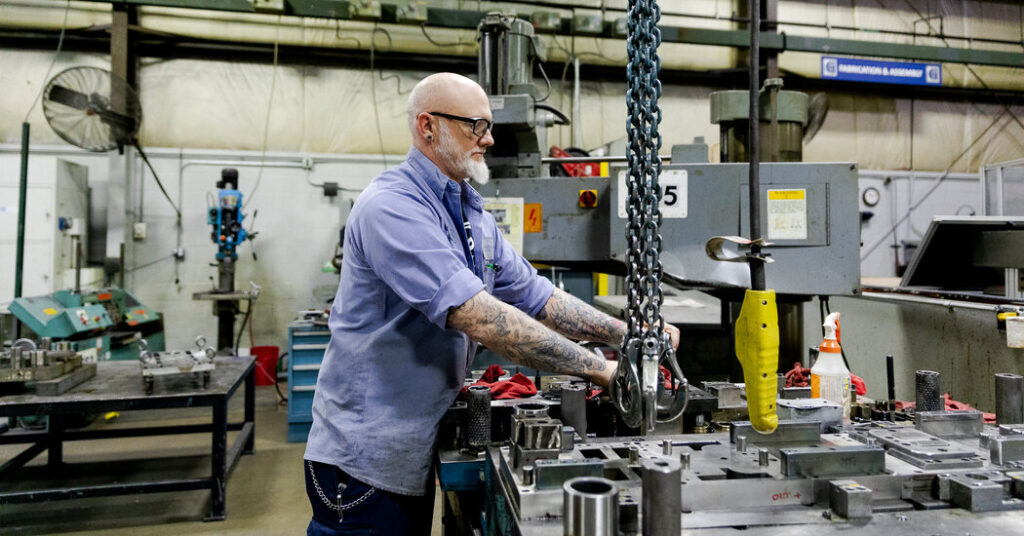
Underneath the overall growth figures is a more complicated story. Consumer spending is being driven primarily by wealthier households. Important sectors of the economy, including housing, are mired in a slump. Mr. Trump’s trade policies have taken a toll on farmers and factories, and driven up the price of imported goods.
Two forces drove the strength of the economy last year: consumer spending and artificial intelligence.
Consumer spending, long the engine of U.S. economic growth, increased at a 2.4 percent rate in the fourth quarter, and grew 2.2 percent over the full year. Low unemployment and rising wages helped lift spending, as did a strong stock market — itself partly the result of investor enthusiasm for A.I.-related companies.
The race to develop and deploy ever-better artificial intelligence models, meanwhile, contributed to growth because of the industry’s voracious appetite for data centers and the electricity to power them. Many of the chips and other components that go into such facilities are imported, meaning they aren’t counted in G.D.P. But A.I.-related investments still helped drive the 3.7 percent growth rate in business investment in the fourth quarter.
The A.I. boom helped mask weakness elsewhere in the economy. Construction of new factories fell in 2025. So did home building.
“It’s a winner take all construction economy,” said Anirban Basu, chief economist at Associated Builders and Contractors, a trade group. “If you’re a large general contractor that can manage large data center projects, you’re a winner. If you’re a smaller contractor, the world is increasingly difficult.”
The reliance on A.I. could make the economy vulnerable if investors sour on the industry. So far, however, most forecasters are predicting that growth will accelerate in 2026. Tax cuts passed by Congress last year should help consumers and businesses in the short-term, as should the interest rate cuts that Federal Reserve policymakers enacted late last year. If trade policy also stabilizes in 2026, that will also help businesses become more confident.
Ben Casselman is the chief economics correspondent for The Times. He has reported on the economy for nearly 20 years.
The post U.S. Economy Grew More Slowly at End of 2025 appeared first on New York Times.