The Supreme Court on Friday struck down most of President Donald Trump’s sweeping tariffs, a ruling that deals a major blow to his signature economic policy and represents a stinging political setback.
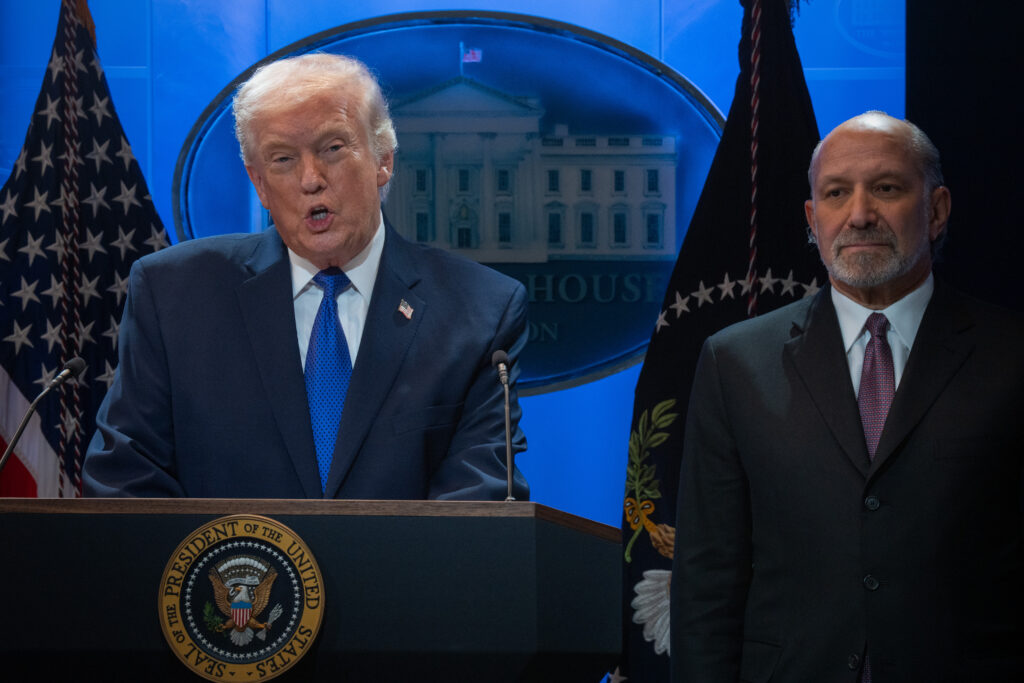
Trump, who has largely been deferential to the high court’s previous decisions, lashed out at the justices in unprecedented terms a few hours after the ruling. At a White House news conference, he called the justices who sided against him a “disgrace to our nation.”
He said he would replace the import taxes the court overturned with a 10 percent global tariff and other levies under trade laws other than the one the court ruled on.
“I’m ashamed of certain members of the court, absolutely ashamed for not having the courage to do what’s right for the country,” Trump said.
The justices’ 6-3 ruling said the president did not have the authority under the 1977 International Emergency Economic Powers Act (IEEPA) to impose a vast array of import levies on goods from nearly all of the nation’s trading partners. The decision imperils the core of the president’s economic agenda and is expected to reverberate widely, affecting global trade, consumers, companies, inflation and the pocketbooks of every American.
The ruling is the most significant check to date on Trump’s bid to vastly expand executive authority in his second term and his most consequential setback before a Supreme Court that over the last year has given a green light to most of his policies in a series of emergency rulings.
Chief Justice John G. Roberts Jr., who wrote the majority opinion, was unsparing in dismissing most of the administration’s key arguments. The ruling was striking in its timing, landing just days before some of the justices are scheduled to attend Trump’s State of the Union address.
“The President asserts the extraordinary power to unilaterally impose tariffs of unlimited amount, duration, and scope,” Roberts wrote. “In light of the breadth, history, and constitutional context of that asserted authority, he must identify clear congressional authorization to exercise it.”
Roberts pointed out IEEPA made no mention of tariffs and that he could find little in the law to authorize such massive levies, writing bluntly: “Those words cannot bear such weight.”
He also said Trump’s move ran afoul of the “major questions doctrine,” a rule the court has enunciated in recent years that holds that any presidential action that has major economic or political ramifications must have explicit authorization by Congress.
The stakes of the ruling are enormous: The tariffs affect trillions of dollars in trade, and the government collected nearly $134 billion in levies through Dec. 14 under the authority challenged in the case.
The majority did not offer clarity, however, on whether the administration will have to enact a massive refund of the funds collected to date.
As Roberts read the tariffs opinion from the bench, Solicitor General D. John Sauer — who argued the case for the Trump administration in November — watched, largely stone-faced. Seated at a table in front of the justices, Sauer’s hands were folded in his lap, with his fingers fidgeting slightly as Roberts got deeper into the opinion.
The justices sent the case back to a lower court for further proceedings, and those judges will probably have to hash out the question of refunds. White House officials have warned a giveback would be a strain on the nation’s finances, require disbursements to more than 300,000 importers and would be a logistical mess. Business groups have said that returning the money is imperative since the administration had no legal authority to take it.
Trump did not commit to refunding the levies at his news conference and said the issue could be tied up in litigation for years.
On Friday, some Democrats called on the Trump administration to begin reimbursing companies.
Justices Sonia Sotomayor, Neil M. Gorsuch, Elena Kagan, Amy Coney Barrett and Ketanji Brown Jackson joined parts of Roberts’s majority opinion. Gorsuch, Barrett and Kagan filed concurring opinions in the case.
In his concurring opinion, Gorsuch rejected the administration’s argument that the president has “substantial discretion” over tariffs. History “does not support the notion that Presidents have traditionally enjoyed so much power,” Gorsuch wrote. “More nearly, history refutes it.”
“Americans fought the Revolution in no small part because they believed that only their elected representatives (not the King, not even Parliament) possessed authority to tax them,” he wrote. “[T]he framers gave Congress alone ‘access to the pockets of the people.’”
In dissent, Justice Brett M. Kavanaugh wrote he “firmly” disagreed with the decision.
“Text, history, and precedent” all show that the IEEPA law was “clearly” used properly, he wrote. “Like quotas and embargoes, tariffs are a traditional and common tool to regulate importation,” Kavanaugh wrote. Justices Clarence Thomas and Samuel A. Alito Jr. joined him in dissenting.
Kavanaugh added that the majority essentially concluded Trump “checked the wrong statutory box” but had several other options to impose tariffs.
“Although I firmly disagree with the Court’s holding today, the decision might not substantially constrain a President’s ability to order tariffs going forward,” he wrote as he listed other laws that Trump could use to continue his trade agenda.
Trump approvingly cited Kavanaugh’s opinion at his news conference and praised the three dissenting justices even as he excoriated those in the majority.
As the president’s Friday announcement indicated, the ruling is not the end of all of Trump’s tariffs. In addition to the new across-the-board tariff, other levies on materials such as steel and aluminum are not affected by the decision.
Nonetheless, the decision represents a major blow to a core part of Trump’s agenda and is a historic ruling on presidential power.
“This is probably the most significant example of the court holding a presidential action illegal since President Truman tried to seize the steel mills during the Korean War,” said Richard H. Pildes, a New York University law professor. “The dramatic nature of this decision should not be underestimated.”
Pildes was referring to a landmark 1952 decision in which the Supreme Court blocked Harry S. Truman from attempting to put steel mills under government control during a strike. The work action threatened production necessary for the war effort, Truman said.
In social media posts, Trump has repeatedly exhorted the justices to uphold the tariffs, warning that their demise would be the “biggest threat in history” to national security and framing the case as “literally, LIFE OR DEATH for our Country.”
Economists say the tariffs have been a drag on the U.S. economy, raising prices for consumers and businesses at a time of concern about inflation. The unemployment rate crept up last year before dropping a bit in recent months. Inflation has remained higher than policymakers would like, despite cooling more than expected in January. U.S. economic growth slowed sharply at the end of 2025.
Despite the tariffs, the nation’s trade deficit has continued at a high level. The deficit in trade of physical goods hit a record $1.2 trillion in 2025, the Commerce Department reported Thursday.
The Supreme Court signaled the importance of the tariff issue by agreeing in September to hear two challenges on an expedited basis. The ruling arrived about two months after the November arguments in the case, a relatively quick decision from the high court.
Trump has said tariffs will revive American manufacturing and protect jobs, but he has wielded them more broadly in his second term as a favored tool to punish enemies, win concessions and give his administration leverage in a range of international disputes.
His habit of imposing massive import taxes — then quickly rolling them back or delaying them — has roiled global trade and occasionally upset the markets, while many voters have expressed concern about price increases and economic fallout.
No previous president has used IEEPA to impose tariffs in its nearly 50-year history. IEEPA has typically been employed to levy sanctions against enemies of the United States.
The law allows the president to declare an emergency to “regulate … importation” of foreign goods to “deal with any unusual and extraordinary threat” to “national security, foreign policy, or economy.”
Trump began announcing emergencies last February, slapping tariffs of between 10 and 25 percent on China, Mexico and Canada for allegedly failing to stem the flow of fentanyl and other drugs across the border.
In April, at an event dubbed “Liberation Day,” Trump announced a universal 10 percent tariff on nearly every U.S. trading partner and higher levies on some nations. Trump said the annual trade deficits that the United States has posted each year since 1975 were an emergency, claiming that they have decimated American manufacturing.
The Yale Budget Lab calculates that the current average tariff rate of about 17 percent is the highest since the Great Depression.
A handful of small businesses and a group of states filed separate lawsuits against the tariffs, saying the levies would mean a major hit for their bottom lines and economies. The small businesses called Trump’s imposition of worldwide levies a “power grab.”
A federal judge, a specialized trade court and an appeals court all ruled against the president in the two cases before the Trump administration asked the Supreme Court to take up the case.
Pratik A. Shah, an attorney for some of the businesses challenging Trump’s tariffs, said in a statement that the court arrived at the right decision.
“The Supreme Court upheld the foundational separation-of-powers principle that our small-business client has been fighting for: No president has boundless power to tax Americans,” Shah said.
The ruling marked a departure from a string of victories for Trump at the high court. The justices have overwhelmingly ruled for Trump in temporary rulings, clearing the way for him to ban transgender troops from the military, give the U.S. DOGE Service access to sensitive data and deeply cut the Education Department as legal challenges play out.
There have been some setbacks. In December, the justices blocked the Trump administration from deploying National Guard troops to Chicago in a significant blow to the president.
Other issues the justices are weighing related to the president’s agenda include whether to clear the way for Trump to fire the heads of independent agencies without cause, which would be one of the largest changes to the structure of the federal government in decades.
The post Trump slams justices after Supreme Court strikes down most of his tariffs appeared first on Washington Post.