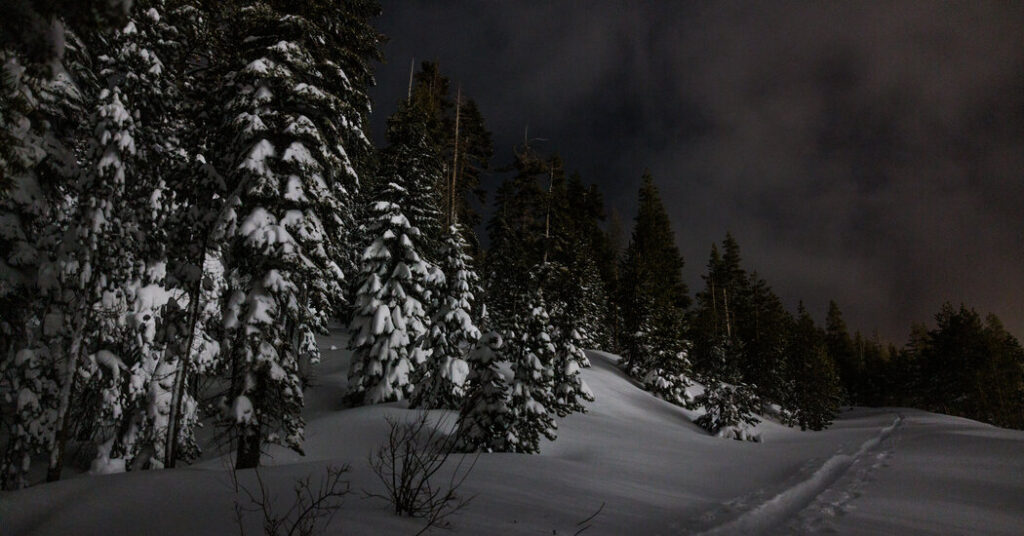
On Sunday morning, two parties moved through the mountains above Donner Summit in opposite directions — one heading out from a cluster of backcountry cabins called the Frog Lake Huts, the other hiking in. The groups never saw each other. Only one would return whole.
The party heading out consisted of four friends who had just spent three days at the huts, perched high on the crest of the Sierra Nevada. Among them was Kurt Gensheimer, a trail builder and backcountry veteran from Verdi, Nev.
“It was the most amazing conditions I can remember,” Mr. Gensheimer said. Bluebird skies, no wind, the mountains to themselves. The biggest storm of the season was bearing down, and the four friends wanted to be gone before it hit.
The party heading in was much larger — clients and guides from Blackbird Mountain Guides, which Mr. Gensheimer described as a highly respected outfit. The same storm that ushered his party out did not, apparently, keep the Blackbird group home.
Two days later, on Tuesday, Feb. 17, the storm claimed at least eight lives. The Blackbird party was on a north-facing slope near Perry’s Point when an enormous slab of snow broke loose, sweeping all 15 members of the group downhill. Six survived, eight were confirmed dead and one remains missing — the deadliest avalanche in the United States in more than four decades.
The group had set out for the trailhead that morning, despite a “high danger” warning issued by the Sierra Avalanche Center before dawn. The center had specifically warned of a “weak layer” expected to reach the point of failure that day. Before noon, a guide shouted, “Avalanche!” before the mountain gave way.
The survivors have not spoken publicly. Until they do, fellow backcountry experts and the broader public can only speculate on how the group arrived at its decisions. How did the skiers decide to embark on the trip despite the foreboding forecast? Were the guides aware of the avalanche warnings, and did the group discuss the risks together? Why did they leave the huts on Tuesday morning, rather than hunkering down? And how did they choose their route down the mountain?
The storm that hit the Sierra buried everything. Three to six feet of snow had fallen since Sunday. Winds gusted to 60 miles per hour. Interstate 80 over Donner Summit was closed in both directions. The six survivors took shelter in a stand of trees with a tarp, texting rescuers through an iPhone satellite SOS system while 46 emergency responders fought through whiteout conditions to reach them. It took hours. Two of the six were hospitalized.
From the smaller party, Mr. Gensheimer and his friend, Tom Beckering, were two of the skiers who made it out.
Mr. Gensheimer, 48, has spent 15 years in the backcountry. Mr. Beckering, 52, a project manager for a landscape company by trade, operates at a different level; he has skied the backcountry for three decades, almost daily, and considers himself a regular at the Frog Lake Huts.
The two men, who host Mind the Track, a podcast about outdoor culture, nearly had to cancel their trip. Weeks of drought had left the mountains covered in old snow, and Mr. Beckering was ready to bail. Then a light midweek weather system dropped fresh powder — what he called a “reset.” The friends arrived on Thursday, Feb. 12, and trekked in.
The huts are not what the word suggests — they are modern cabins with a renovated stone house serving as a communal kitchen. Guests sleep in the cabins and gather in the stone house for meals. The property is staffed by hut keepers who remained on the grounds through the storm, Mr. Beckering said.
On the first day of their trip, Mr. Beckering and Mr. Gensheimer moved cautiously, poking at the snow and skiing mellower terrain to test the stability. As they built confidence, the two men pushed to more aggressive slopes. They skied the Castle Peak area, which normally draws snowmobile traffic but sat empty because the drought had kept machines off the lower elevations.
Days started slowly. Mr. Beckering, who spent years in the restaurant industry before turning to landscape work, cooked big breakfasts in the stone house kitchen of potato hash, bacon and eggs. But the approaching weather was part of the conversation among the roughly 16 people staying in different groups at the huts that week. Mr. Gensheimer remembers the calculus as unanimous: Get out Monday, or hunker down until Thursday.
“Wherever you are on Tuesday,” he said, “is where you want to stay.”
The wind rose Saturday night. By Sunday, the sky cleared one last time. On the way out, the party skied sun-softened snow and was back in Truckee, Calif., by the afternoon, Mr. Gensheimer standing around in short sleeves. In less than 24 hours, he remembered thinking, it would be “nuking” snow.
What killed at least eight people on Tuesday, Mr. Gensheimer said, was not a simple story of too much weight on an icy surface.
David Reichel, executive director of the Sierra Avalanche Center, explained that the conditions became lethal as the massive storm delivered heavy snow on top of a base that had been transformed by an exceptionally dry January and start to February. The fresh snow, he said, fell on a “layer of snow that weakened and became unstable during the warm, dry weather.”
Mr. Gensheimer saw the same thing from the vantage point of the slopes. The light dusting of snow that had provided such good skiing for his party had, during the sunny days that followed, begun to change. Without new snow to pack it down, the sun and air turned the surface into something resembling loose, dry sand. When the storm finally dumped a heavy slab of new snow on top, Mr. Gensheimer said, that sandy layer acted like a tray of ball bearings. It created a hidden trap — a slick, unstable floor where the entire mountainside could simply let go.
Blackbird Mountain Guides itself had identified the problem. On Monday — the day before the avalanche — the company posted a video on Instagram showing what it described as “atypical layering” and warning of “a particularly weak layer in many northerly aspects.” The avalanche the next morning occurred on a north-facing slope.
Before dawn on Tuesday, Mr. Reichel’s forecasters had raised the avalanche danger warning to high. They determined, Mr. Reichel said, “to the best of their abilities” that conditions were lethal.
Then the forecasters lost the mountain. Visibility dropped to near zero. “I couldn’t see anything all day,” Mr. Reichel said. Working only from remote sensors and weather models, his team watched from afar as the storm took hold.
The huts the Blackbird party left on Tuesday were not in danger, according to both Mr. Gensheimer and Mr. Beckering. Mr. Gensheimer said that the property did not sit in an avalanche path and could withstand major snow loads.
If the party had simply stayed until Thursday, Mr. Gensheimer said, the members would have walked out alive. What the backcountry world is grappling with now is why they didn’t.
A longer, flatter route east — rated “simple” on the land trust’s own website — might have taken the group out with less avalanche exposure. The route the Blackbird party appears to have taken is rated “complex,” with what the land trust described as “many avalanche starting zones and terrain traps.”
Neither man was there on Tuesday. They do not know what the Blackbird guides knew or what led to the decision to leave. What Mr. Gensheimer does know is that at least eight people are dead — among them six women identified by their families as mothers, wives and close friends connected through a love of the outdoors. Three of the dead were Blackbird guides. He has friends who work for the company.
Mr. Beckering brings a different frame. For someone who has spent three decades in these mountains, big weather in the Sierra is not something to sit out — it is something to navigate. A high-danger rating does not mean a skier stops, he said; it means he chooses safe terrain.
In a text message after an interview, Mr. Beckering offered a sobering assessment. If his own party had needed to get out on Tuesday, he would have taken the route the Blackbird guides took, he said. Even with all his years in the backcountry, Mr. Beckering said, he would have thought it was a “go.” This was, in his words, a “rare bird” avalanche — not skiers charging into a known path, but people traversing a route that does not usually prove fatal.
“Right now is not a time to be critical,” Mr. Beckering said. “It’s a time to support.”
On Thursday, the weather broke. The sky cleared over Donner Summit. Fresh snow had reloaded the slope overnight, and the bodies remained unreachable. But the sun was out. Mr. Gensheimer said that the Blackbird party could have walked out that day and been home by the afternoon.
Amy Graff contributed reporting.
Kurt Streeter writes about identity in America — racial, political, religious, gender and more. He is based on the West Coast.
The post These Skiers Cleared Out as Group That Would Be Hit by Avalanche Arrived appeared first on New York Times.