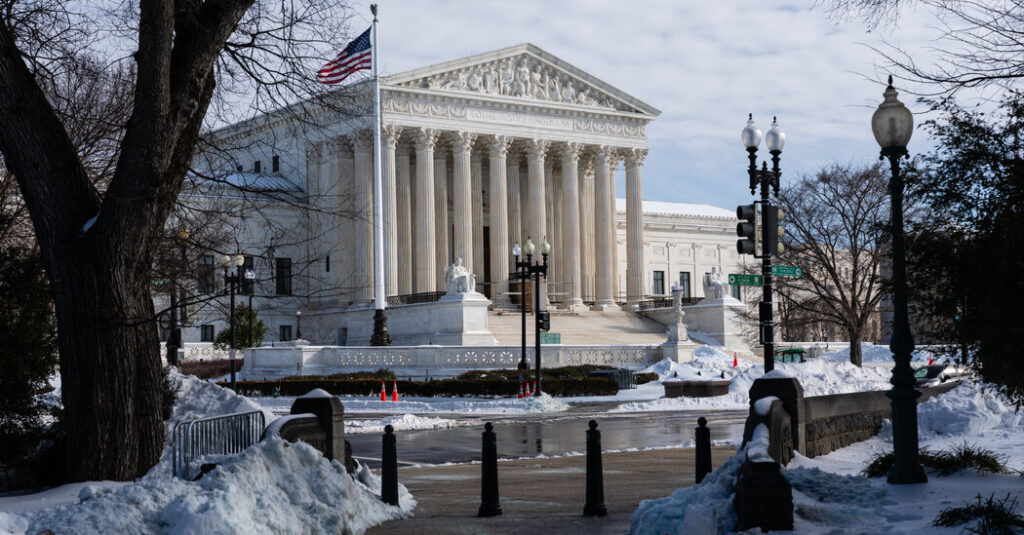
A trio of conservative justices on Friday warned that the court had overstepped its bounds in its decision to block President Trump’s emergency tariffs, arguing that the president should be able to impose tariffs under his power to conduct foreign affairs.
In a 63-page dissent, written by Justice Brett M. Kavanaugh, who was joined by Justices Clarence Thomas and Samuel A. Alito Jr., the dissenters also raised concerns that the decision would lead to chaos, at least in the short term as importers who have already paid the tariffs seek refunds.
“The United States may be required to refund billions of dollars to importers who paid the IEEPA tariffs, even though some importers may have already passed on costs to consumers or others,” Justice Kavanaugh wrote, referring to an acronym for the 1970s emergency statute Mr. Trump invoked to impose tariffs. He noted discussion at oral arguments about how such a refund process was likely to be a “mess.”
He also noted that the administration had used the leverage of tariffs to enter into key trading deals with other nations. Mr. Trump, he wrote, “helped facilitate trade deals worth trillions of dollars — including with foreign nations from China to the United Kingdom to Japan, and more.”
The court’s ruling “could generate uncertainty regarding those trade arrangements,” he wrote.
Even as Justice Kavanaugh warned of dire consequences from the court’s decision, he sounded optimistic about the ability of President Trump to continue imposing tariffs.
Justice Kavanaugh wrote that although he “firmly” disagreed with the outcome, “the decision might not substantially constrain a President’s ability to order tariffs going forward.”
He laid out several potential pathways for the president to impose tariffs, adding that these other federal statutes “might justify most (if not all) of the tariffs at issue in this case.” He added, however, that those statutes might require additional steps that the emergency law Mr. Trump has so far cited does not.
He listed specific sections of several federal laws, including the Trade Expansion Act of 1962, the Trade Act of 1974, and the Tariff Act of 1930, writing that the majority had concluded that “the president checked the wrong statutory box” by relying on the emergency law.
Abbie VanSickle covers the United States Supreme Court for The Times. She is a lawyer and has an extensive background in investigative reporting.
The post In Dissent, 3 Justices Warn Tariff Decision May Unleash Chaos, at Least in Short-Term appeared first on New York Times.