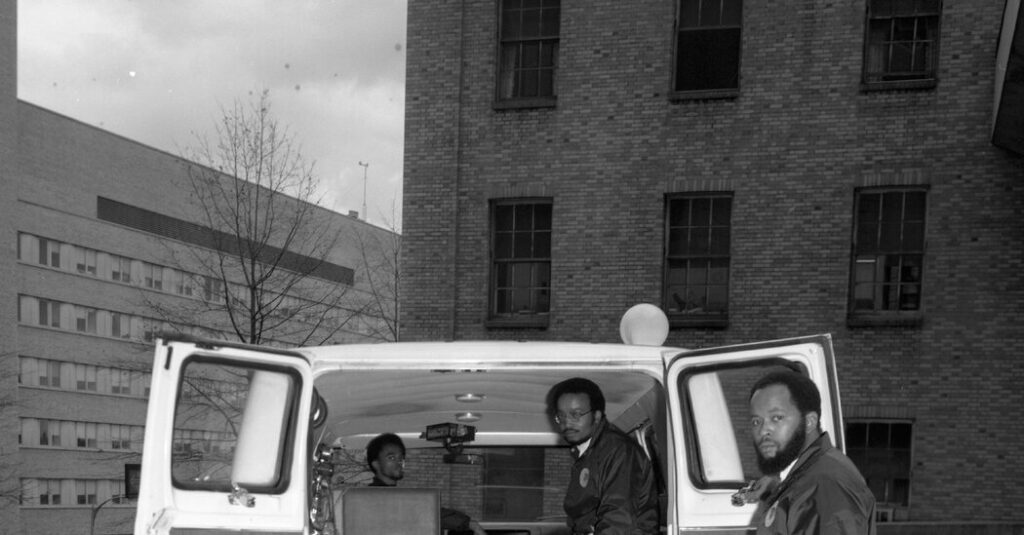
Larry Underwood, a nursing assistant by day and jitney cabdriver by night, was talking with a fellow driver some years ago about their younger days. Mr. Underwood mentioned that he had worked for Freedom House.
It was a nod to a history that had been mostly forgotten: the working-class men and women, most of them Black, who were part of the Freedom House Ambulance Service and who, in the late 1960s and early 1970s, were among the most highly trained field practitioners of emergency medical care in the country.
They were performing CPR, administering IVs, inserting breathing tubes and transmitting EKGs on the streets of Pittsburgh well before such care became standard elements of emergency medical treatment.
And then they were gone, casualties of their own pioneering work, which helped lead to the creation of local emergency medical services, like the one that would essentially replace Freedom House.
In the 2000s, at the jitney stand, Mr. Underwood was surprised that his fellow driver had even heard of it. “Freedom House?” the man said. “You were one of them guys?”
These days, Mr. Underwood, 76, is having a hard time managing all the speaking engagements.
The spotlight has finally found Freedom House. In recent years it has been the subject of documentaries, a book and even an episode of “The Pitt,” the Emmy-winning drama set in a Pittsburgh trauma center.
And on Friday, U.S. Representative Summer Lee, Democrat of Pittsburgh, is introducing a resolution to award Freedom House with the Congressional Gold Medal, the highest civilian honor a person or institution can receive from Congress. The resolution is being co-sponsored by Representative Mike Kelly, a Republican whose district is also in western Pennsylvania, along with more than a dozen members of Congress from both parties.
With the Trump administration removing museum exhibits and programs that highlight Black history, it might seem like a fraught moment to push to celebrate an organization like Freedom House. But Ms. Lee said that its legacy deserved national recognition.
“This is a group of people who revolutionized the way we do medicine, the way that we do pre-hospital services,” she said in an interview. “It was a benefit to everyone.”
In the mid-1960s, when a person had a medical emergency, a police wagon or hearse would usually arrive on the scene. The patient would be put in the back, alone, and taken to a hospital. Only then would lifesaving treatment start, which was often too late. A 1966 government study reported that the chances of survival for someone who was seriously wounded were greater in a combat zone of Vietnam “than on the average city street.”
This was a particularly stark reality in Black neighborhoods, where the relationship with the police was often strained. Mitchell Brown, who in 1965 was living in Pittsburgh’s Hill District, which was predominantly Black, recalled having to carry his collapsed mother out of his house and into a wagon because the police who responded decided she was drunk, not sick. He later learned that she had suffered a cerebral hemorrhage, he said. She died within days.
With federal anti-poverty money coming into Pittsburgh, the Falk Foundation, a local philanthropy, saw a need and opportunity. Its president, Philip Hallen, envisioned the Hill district having its own medics, who would be based at Freedom House, a neighborhood nonprofit.
For training, Mr. Hallen sought the advice of Dr. Peter Safar, an anesthesiologist at the University of Pittsburgh. Already famous for having developed CPR, Dr. Safar had been preaching the importance of rendering emergency medical care to patients before they reached the hospital.
In 1967, the first Freedom House class — 25 Black men, some recently home from combat tours in Vietnam, some with criminal records, many without high a school diploma — began their paramedic training. For months they studied anatomy and physiology and learned how to defibrillate patients, drive an ambulance, and perform advanced first-aid. They were educated in hospitals and on the streets, and quickly discovered the value of their lessons.
George McCary III, then a 19-year-old trainee living with his grandmother in public housing, was roused from his bed one night. Someone in the building had overdosed. Remembering his coursework, he checked the man’s vital signs and positioned his head to open up the airway.
“I actually saved him, actually pulled him back to some kind of reality,” recalled Mr. McCary, now 77.
Over the next several years, the men and women of Freedom House would respond to thousands of calls in the Hill District and neighboring downtown. Most of the patients were Black, though Mr. Brown, who had joined Freedom House, remembered coming to the aid of a white man who assailed them with racial slurs during his treatment. Local police were often reluctant to notify Freedom House about emergencies, so the group brought in a police scanner to follow the calls themselves.
Even as Freedom House struggled with funding and mistrust from local officials, it soon became known that Black residents in the poorest parts of Pittsburgh were getting the best trauma care in the city. In 1975, the mayor, Peter Flaherty, never a supporter of the program, created the Pittsburgh EMS and defunded Freedom House. The members were invited to join the city’s emergency service. But many said that despite what they were promised they were treated as inferiors.
John Moon, 76, described watching his white supervisors struggle to perform procedures he had been doing for years, while he was told to do little more than observe. “I couldn’t drive the truck, couldn’t examine the patient, couldn’t talk on the radio,” he said.
Still, Mr. Moon stuck with the Pittsburgh EMS, working his way up and retiring after three decades as assistant chief. In 2023, Amera Gilchrist, a paramedic he had mentored, became the first Black woman to lead the Pittsburgh EMS.
But most Freedom House members, faced with so many indignities, did not want to work for the city, though many continued to work in emergency medicine. Dr. Nancy Caroline, who had been the program’s medical director, went on to write the seminal textbook for paramedic trainees. Mr. Brown later became the director of the Ohio Department of Public Safety.
Despite occasional moments of attention, Freedom House seemed to be largely forgotten, even as its approach to trauma care became standard protocol in ambulances nationwide.
“We were so far ahead of our time it boggles my mind,” Mr. Moon said.
About five years ago, Dr. Sylvia Owusu-Ansah, a pediatric emergency doctor who was relatively new to Pittsburgh, attended a panel about Freedom House. It was the first time she had heard of it, and she was astounded. “That is what you want in a health care system, right?” she said. “The most vulnerable population, the people with the least, get immediate access because they otherwise wouldn’t. And then: Poof, it’s gone.”
Dr. Owusu-Ansah talked it up to political leaders, including Representative Lee, and she introduced Freedom House to the writers for “The Pitt.” She wanted to ensure that this time, the recognition for Freedom House would last.
It has been bittersweet, for some veterans of the program, to consider what could have been had their contributions been appreciated years ago. But Mr. Moon said he was focusing on the good.
“This organization weathered setbacks and disappointments and broken promises and frustrations to create a system that this country takes for granted today,” he said. “That’s the legacy. I can’t spend my time whining about what somebody else did.”
Campbell Robertson reports for The Times on Delaware, the District of Columbia, Kentucky, Maryland, Ohio, Pennsylvania, Virginia and West Virginia.
The post Black Medics, Ahead of Their Time, Gain Belated Recognition appeared first on New York Times.