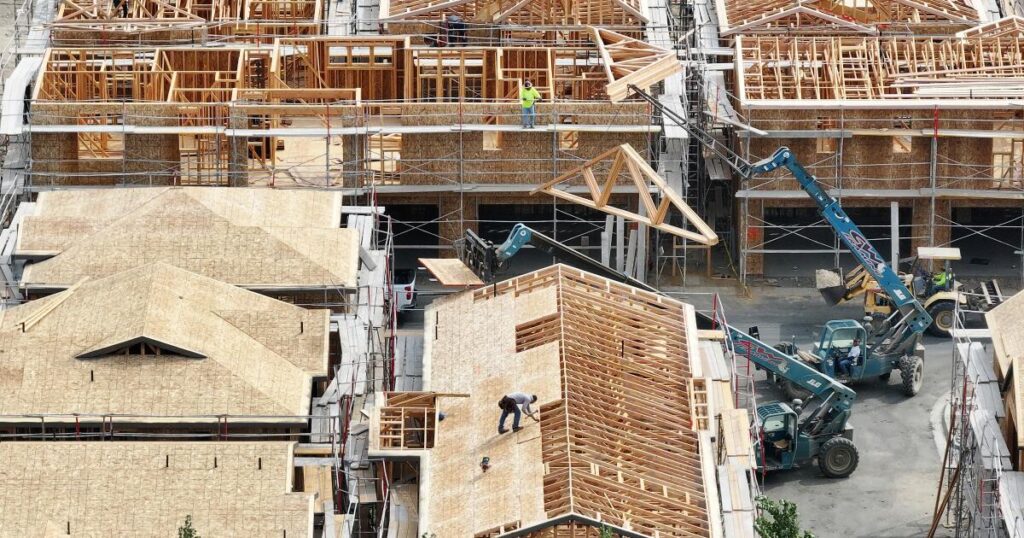
America’s housing crisis is no longer a looming threat: It’s here. Across the country, home prices and rents have climbed beyond reach for millions of families. While many factors play a role, from zoning laws to inflation, one root cause is often ignored: We simply don’t have enough construction workers to build the homes America needs.
The construction industry must add roughly 723,000 workers every year through 2028 just to meet demand. Years of underinvestment in trade education have contributed to a structural shortage that’s now costing the economy an estimated $10.8 billion annually in delayed projects and unbuilt homes. That’s not a future risk; it’s a current cost for every American household in the form of higher rents and home prices.
I’ve seen this crisis from both sides of the table. As a former chair of a state workforce board and now a partner in real estate development, I witness the same disconnect everywhere: young people searching for opportunity, and an industry desperate for labor. Job sites across the country can’t find electricians, plumbers, framers or HVAC technicians. Projects are delayed, scaled back or canceled. This isn’t just a workforce challenge; it’s a housing and economic growth emergency.
Yet there’s a powerful irony here. Construction is one of the most promising and well-paying career paths in the country. According to the newly released Home Builders Institute report, average wages for homebuilding jobs across the country surged more than 9% over the past year, and the average non-supervisory construction worker now earns more than $35 an hour, well above the private-sector average. The message from the market couldn’t be clearer: There’s tremendous demand for builders, and incredible opportunity for anyone willing to learn the trades.
There are some bright spots of progress. Women’s participation in construction has reached a 20- year high, and more Gen Z workers are entering the industry. These new faces are proof that outreach and changing perceptions work, but the progress isn’t keeping pace with the need. The median age of a construction worker is in the 40s, and retirements are accelerating. If we don’t act now, the gap between supply and demand will widen, homebuilding will slow even further, and housing costs will continue to soar.
The solution can only be a national workforce mobilization on the scale of the housing crisis itself. Federal and state governments should prioritize funding for construction training, through expanded vocational education, apprenticeships and community college partnerships. Congress should ensure workforce dollars for the building trades are included in any infrastructure or competitiveness legislation, just as it has for semiconductor jobs. The private sector should do its part too: Developers and builders ought to sponsor apprenticeship programs and create clear career pathways for young workers and members of underrepresented groups.
We also need a cultural reset. For too long, America has pushed a “college or bust” mindset that dismisses the trades as second-class options. That’s wrong, and it’s hurting our economy. Trades are the backbone of the middle class and vital to our nation’s growth. We should celebrate and elevate these jobs: Carpenters, masons and electricians are nation builders in the truest sense. A coordinated public-private campaign could help change perceptions, attract new talent and close the workforce gap.
Some argue that technology will solve this shortage. It won’t, at least not anytime soon. Despite new tools such as AI-assisted design, construction still relies on human hands. Algorithms don’t frame houses or wire electrical systems. The short-term housing crunch requires trained workers at every site.
If we fail to act, the housing deficit, already more than 1.5 million homes, will deepen; millions of families will remain priced out of homeownership. Employers in the construction trades will struggle to attract workers and inflation will persist. All of this slows economic growth. But if we invest in people, we can reverse course: More training means more homes, more stable prices and stronger communities.
This need is about more than economics. It’s about the American promise. Every generation before us has faced moments that demanded big investments in our workforce — from the manufacturing mobilization of World War II to the tech revolution that defined recent decades. We can meet this moment too, by training and empowering the next generation of builders.
We know what needs to be done. The question is whether we have the will to do it. Every month we delay adds billions in hidden costs and pushes the dream of affordable housing further out of reach. The $10.8 billion we lose each year to labor shortages isn’t only theoretical, in the homes not built: It is tangible in the rents that rise and the families waiting for a chance to build their future. America can’t afford to wait any longer.
Angelo Farooq is a general partner at AlphaX RE Capital and a former chairman of the National Assn. for State Workforce Board Chairs.
The post Closing the labor-force gap is the only fix for the housing crisis appeared first on Los Angeles Times.